
 READ HABITABLE’S NEW REPORT
Designing Out Plastics: A Blueprint for Healthier Building Materials
 Climate Change
It is critical that these efforts align their goals lest, once again, the latest definition and marketing of “green” building products overlooks and overrides the interests of the front line communities most impacted by both climate change and toxic pollution.
The Carbon Leadership Forum describes embodied carbon as “the sum impact of all the greenhouse gas emissions attributed to the materials throughout their life cycle (extracting from the ground, manufacturing, construction, maintenance and end of life/disposal).2 In a widely praised book, The New Carbon Architecture3, Bruce King explains clearly why reducing carbon inputs to building materials immediately—present day carbon releases—is more effective at meeting urgent carbon reduction goals than the gains of even a Net Zero building, which are realized over decades. This approach is embraced by the Materials Carbon Action Network, a growing association of manufacturers and others, which states as its aim “prioritization of embodied carbon in building materials.”(emphasis added).4
Climate action priorities are framed differently by groups at the forefront of movements for climate justice and equity in the green building movement. Mary Robinson, past President of Ireland, UN High Commissioner on Human Rights and UN Special Envoy on Climate Change, says climate justice “insists on a shift from a discourse on greenhouse gases and melting ice caps into a civil rights movement with the people and communities most vulnerable to climate impacts at its heart.” 5 The Equitable and Just National Climate Platform6, adopted by a broad cross section of environmental justice groups and national organizations including Center for American Progress, League of Conservation Voters, Natural Resources Defense Council, and Sierra Club, calls for “prioritizing climate solutions and other policies that also reduce pollution in these legacy communities at the scale needed to significantly improve their public health and quality of life.” The NAACP’s Centering Equity In The Sustainable Building Sector (CESBS)7 initiative advocates “action on shutting down coal plants and other toxic facilities at the local level, as well as building of new toxic facilities, with advocacy to strengthen development, monitoring, and enforcement of regulations at federal, state, and local levels. Also includes a focus on corporate responsibility and accountability.”8
The embodied carbon and climate justice initiatives are aligned when carbon reductions in building products are achieved through industrial process changes that reduce the use of fossil fuels and other petrochemicals. But rarely, if ever, can building products be manufactured with no carbon footprint, i.e. without fossil fuel inputs. These initiatives may not be aligned when manufacturers promote “carbon neutral” or “carbon negative” products that rely on carbon trading or offsets, the practice of supporting carbon reduction elsewhere (by planting trees or investing in renewable energy) to offset fossil fuel and petrochemical inputs at the factory. According to the Equitable and Just National Climate Platform: “ . . . these policies do not guarantee emissions reduction in EJ communities and can even allow increased emissions in communities that are already disproportionately burdened with pollution and substandard infrastructure.” They may also allow increased toxic pollution, if a manufacturer chooses to invest in carbon offsets, for example, rather than invest in process changes that reduce toxic chemical use or emissions. As a result, disproportionate impacts, often correlated with race, can be perpetuated.
Vinyl provides one example of such inequity. Vinyl’s carbon footprint includes carbon tetrachloride, a chemical released during chlorine production that is simultaneously highly toxic, ozone depleting, and a global warming gas 1,400 times more potent than CO2. Offsetting these releases with tree planting or renewable energy purchases does nothing for the toxic fallout, from carbon tetrachloride, fossil fuels and other petrochemicals, on the communities adjacent to those manufacturing facilities.
Experts agree that the most embodied carbon reductions by far are to be had in addressing steel and concrete in buildings. Beyond that, experts disagree about the strength of the data available to track carbon reductions and compare products in a meaningful, objective way, and warn of diminishing returns relative to the investment needed to track carbon in every product. These may prove to be worth pursuing, but not at the expense of meaningful improvements to conditions in fenceline communities.
Habitable believes that these approaches can be reconciled and aligned through dialogue that includes the communities most impacted by the petrochemical infrastructure that is driving climate change. Our chemical hazard database, Pharos, and our collaboration with ChemFORWARD provide manufacturers with the ability to reduce their product’s carbon and toxic footprints.
We can in good faith pursue reductions in embedded carbon and toxic chemical use, climate and environmental justice and to define climate positive building products accordingly. Prioritizing selection of products simply upon claims of carbon neutrality, however, is not yet warranted.
 Equity
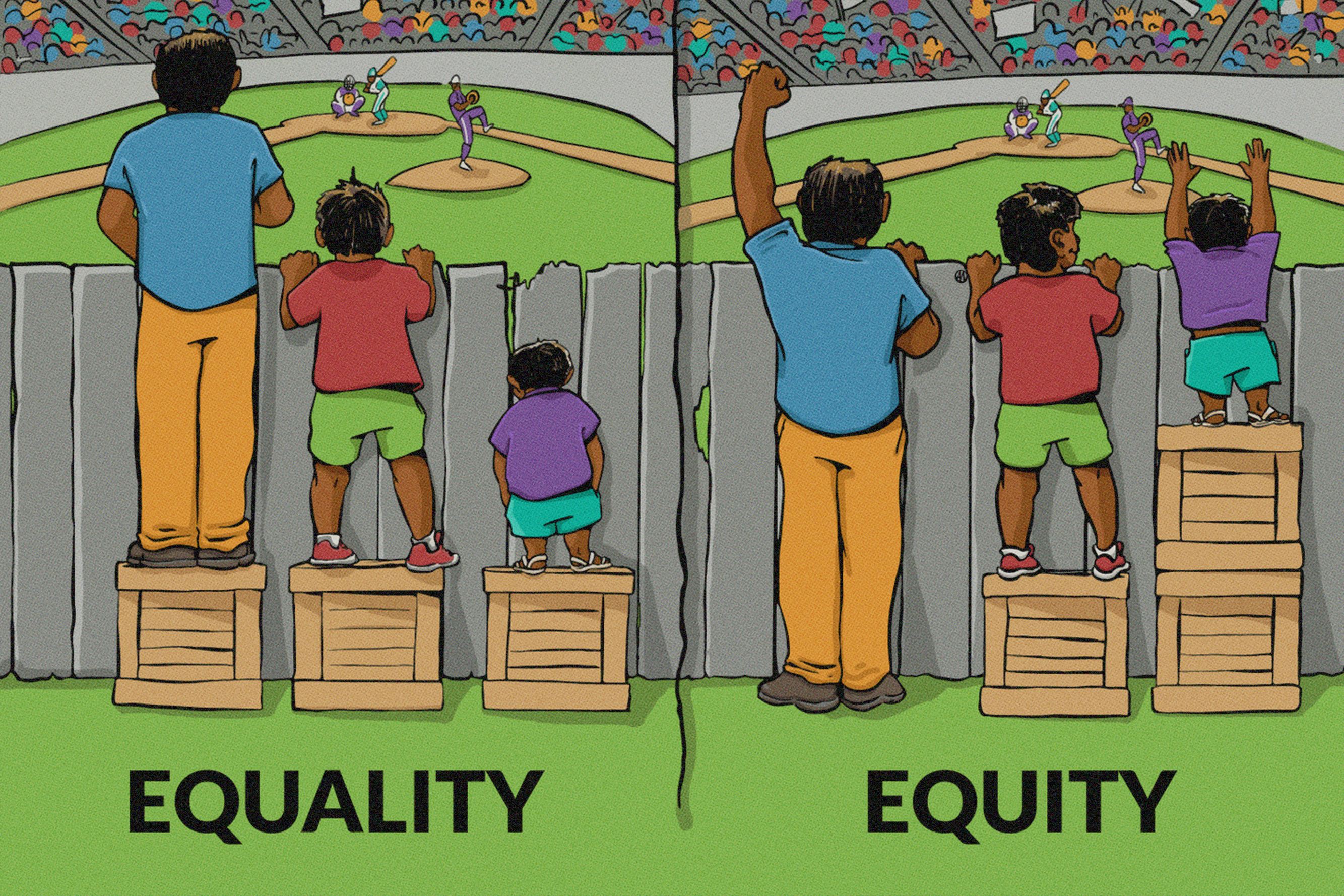
A whole lot of meaning is packaged in the word equity—a term Webster’s defines as “fairness or justice in the way people are treated.” However, the easiest way to understand equity is often through pictures, like the one below.
While this photo considers height as an inequity, in real life, income, access to food and health care are often at the heart of equity discussions. Surprisingly, a critical topic often overlooked in the equity discussion is where we spent 90 percent of our lives—in buildings.1
Oregon Metro, otherwise known simply as Metro, released a report discussing toxics reduction and equity. Its section on building materials connects building materials and equity, calling attention to the need to reduce community exposure to toxic building materials in an equitable manner. Building materials seem harmless and inert in our homes, offices, schools, or cafes. But in 1991, the Environmental Protection Agency (EPA) characterized indoor air pollution as “one of the greatest threats to public health of all environmental problems”.2
A large proportion of indoor air pollution stems from building materials.3 In particular, asthmagens are of highest concern and contribute to indoor air pollution through the release of chemicals from the surface of building finishes.4 For example, carpet, furniture and wall decor release chemicals through degradation or abrasion.5 The chemicals end up in dust in our homes and can enter our bodies through the lungs, skin or mouth.6 Volatile organic compounds emitted from paints are also of concern.7 In fact, a study of children in Australia showed a strong association among indoor home exposure to VOCs and increased risk of asthma.8 Over 70 percent of building material asthmagens identified by Healthy Building Network (HBN) researchers are not covered by leading indoor air quality testing standards.9 These hazardous wastes and products used in building materials disproportionately affect historically marginalized communities of color, children and low-income families.10
Equity in housing is especially important for many families with low incomes who live in multifamily housing.11 Multifamily housing often poses challenges to achieving better air quality as pollutants easily travel between units due to inadequate ventilation. Residents are usually unable to improve building infrastructure themselves.12
Incorporating building materials into the equity discussion is only part of the solution. Product testing for chemicals of concern, biomonitoring, community health impact research, chemicals research, advocacy and education all stand to make a larger collective impact.13
For funders looking to increase diversity and equity initiatives in their grant making, the building industry provides a blooming landscape to foster substantial impact within communities. Here are some key questions to consider when funding proposals:
So often, sustainability standards and initiatives are cost prohibitive, developed for those with the most access and resources, in hopes that “someday” the solutions will trickle-down. In the meantime, children and the populations with the lowest income continue to bear the burden of toxic exposures and preventable health consequences. Habitable’s Informed™ healthy product guidance is changing that old, unsuccessful paradigm. Our resources will result in healthier products for everyone, and amplify the prospect for a healthier planet.
Visit informed.habitablefuture.org to join the movement towards a healthy future for all.
 Health
Healthy Building Network (HBN) has expanded Pharos to include 14 subclasses of toxic flame retardants likely to be banned from use in children’s products by the US Consumer Product Safety Commission.
This follows a recent report from the National Academies of Science (NAS), “A Class Approach to Hazard Assessment of Organohalogen Flame Retardants,” which recommended evaluating similar flame retardants together as “the only possible practical approach.” HBN has championed this class-based approach because the alternative, regulating chemicals one at a time, often leads to regrettable substitutions, in which the simplest replacement for a hazardous chemical is a structural relative with similar desirable properties and similar toxicity.
In this report, NAS divided the broad class of organohalogen flame retardants into 14 subclasses based on a combination of chemical structure and predicted biological activity. The subclasses contain between 4 to 22 chemicals, though the NAS report emphasizes that this inventory is not necessarily comprehensive. HBN has incorporated these 14 subclasses (listed below) as compound groups, to make it easier for the community to review and discuss them. If you’re not a member of Pharos yet, you can register for free and see the hazards of the chemicals in two of the subclasses (alicycles or benzene aliphatics). Not surprisingly, within a subclass, many chemicals share the same hazards!

Compound groups are groups of chemicals that share structural or chemical features. In most cases, chemical regulations restrict the use of individual substances, though in some cases, they restrict a group or class of chemicals, such as organohalogen flame retardants or lead compounds. In cases like these, HBN creates a compound group for each class (and subclass) of chemicals. While a class-based regulatory approach can be more comprehensive, it can also be difficult to implement, since regulatory agencies rarely specify the chemicals within a group. To facilitate implementation of these restrictions, Pharos staff assigns specific chemicals to compound groups, making sure warnings from hazard lists are associated with them. This allows manufacturers to be confident that when they screen their product ingredients in Pharos, they will be alerted to any relevant regulations or hazards. This can also make it easier for companies using these chemicals to assign the appropriate hazards to improve communication about workplace safety.
These 14 new compound groups join over 600 other compound groups populated by Healthy Building Network’s research team and are available in our Pharos tool. Use these tools today to look up hazard data on over 140,000 chemicals for 22 hazard endpoints from >80 authoritative data sources. You can also search for chemicals by function, and use comparison tools to find safer alternatives.
As with all work in Pharos, compound groups are open and collaborative. We welcome suggestions for additions and invite all members of the community to initiate and engage in discussions about these and other chemical hazard issues.
14 Subclasses of Halogenated Flame Retardants
HealthYou may know the phrase, “you are what you eat.” There is a parallel concept when it comes to hazardous chemicals—you are what surrounds you!
Every day we come in contact with a large number of chemical products. Think of the last time you walked through a space being remodeled, or sat in a new car and thought “what’s that smell?” Your body notices that smell because a chemical or substance is interacting with the smell receptors in your nose. The same characteristics that allow it to interact with your nose could make those chemicals affect the body in other ways too—sometimes causing harm. The more invisible moments occur when sleeping on your mattress filled with flame retardants or using your personal care products while getting ready for work. Perhaps you work in a factory, as a contractor installing products, or some other job requiring direct contact with a variety of chemicals. The list (both visible and invisible) goes on and on. While a one-time exposure might not lead to health effects, a life-time of exposure and buildup to these chemicals can. More and more scientific evidence links these chemical exposures to diseases like cancer and diabetes, as well as developmental delays, reproductive health issues, and Autism Spectrum Disorder1.
There are three main exposure pathways: 1) inhalation – breathing in contaminated air, 2) ingestion – the inadvertent passing of dust or other chemical residues from hands to mouth, and 3) because our skin is like a sponge – absorption through dermal contact. According to the Environmental Working Group (EWG), babies still in the womb are exposed to more than 200 chemicals that pass from their mother through the umbilical cord2. This should make you wonder—what are the chemicals I may not realize are entering my body? There is a term used to describe the load of chemicals in the human body—body burden.

We sat down with Teresa McGrath, Healthy Building Network’s (HBN) Chief Research Officer earlier this year to talk about urine, specifically hers. Earlier this year, Teresa participated in a study on chemical body burden led by Silent Spring Institute. Teresa is an avid runner who’s completed marathons and loves snacking on fresh vegetables from her local farmers market. She is one of the healthiest and most health conscious individuals on our team and we were very interested in learning her results.
The study, titled Detox Me Now, included approximately 350 participants. Teresa submitted her urinary sample for testing 15 chemicals, including3:
Her study results detected seven of the 15 chemicals tested in her urine sample. There are a couple of basic rules to follow when it comes to interpreting biomonitoring results. The first is that a higher number is not always a reason for concern4. And the second is that from a hazard perspective, not all chemicals are the same5. Each chemical possesses its own set of health effects at different dosages and routes of exposure6.
During our conversation, Teresa McGrath offered a particularly interesting study finding—her differing bisphenol results particularly when compared to the study median and the US median.
This study tested for two bisphenols, bisphenol-A (BPA) and bisphenol-S (BPS). If BPA sounds familiar, that is probably because this is the much-talked about ingredient commonly used in polycarbonate plastic bottles, lining for food and beverage cans and thermal paper receipts. It can cause endocrine disruption.7,8 BPS is a common replacement for BPA in many thermal applications including paper receipts and plastics and has similar health concerns as BPA9. Teresa’s results for BPA were lower than the median for the Silent Spring Detox Me Now study participants AND lower than the US median10. However, her BPS levels were greater than her BPA levels, greater than the median for the Silent Spring Detox Me Now study participants AND greater than the US median11. This is illustrated in the following graphic from her study report.
The report offers two possible explanations:
By simply purchasing BPA-free products, one can reduce exposure to BPA. However, industries continue to choose “regrettable substitutions” or replacing one chemical with another similar chemical and/or a chemical with unknown health effects. Much of our work focuses on helping industries avoid regrettable substitutions.
Wrapping up our conversation with Teresa, we briefly discussed the overall study implications and additional survey results. Compared to the National Health and Nutrition Examination Survey (NHANES) conducted by the Centers for Disease Control, participants of this study possessed lower chemical burdens than most people in the United States. One explanation for this may be attributed to 43 percent of participants self-reporting that they avoid products with parabens, BPA, triclosan, and fragrance, and an additional 40 percent reported avoiding two or three of those chemicals.
So, how can you reduce your exposure? Silent Spring offers some ideas, including:
You can also download their Detox Me Now App for more tips.
Biomonitoring studies similar to Silent Spring’s are springing up in recent years, as have articles about their results, such as this story in the Guardian. For only a few hundred dollars, consumers can know the exact chemical composition of their bodies. For those who find sample submission undesirable, HBN has added a new feature in our Pharos platform that provides links to biomonitoring databases with information on chemicals identified in the bodies of individuals from different regional communities. The results continually shed light on the need for greater industrial transparency and a transition to safer products.
This is one more example of why HBN passionately paves the way to safer products, offering recommended alternatives from expert chemical analysis and by fostering collaborative industry partnerships.
Climate ChangeCurrent climate action plans are bold, they are necessary, they feel impossible, and they are coming into the consciousness of all concerned (and unconcerned), decades after the early reports should have been taken seriously.
At this point, there is an urgency because people are now experiencing the effects of a warming planet:storms, fires, rising tides, health impacts from warmer temperatures, and more.
To date, climate plans have focused on strategies related to renewable and clean energy, greater efficiency, emissions reduction, etc., especially as it relates to building operations and transportation. However, that is only one side of the (enormous) coin, and it misses key opportunities on the opposite side. It is akin to making the decision to improve your health by incorporating an exercise plan, but continuing a diet of nutritionally deficient and unhealthy foods. You will only get so far, and your dedication to exercise will be undercut by your fast food burgers and supersized fries.
The other side of the coin? If building and transportation energy and emissions reduction is “heads,” what could be so immense that it fills the flipside? The “tails” of that coin is the vast quantities of products being produced, its emissions and pollution, and the need for toxic chemical mitigation. The missing piece in effective climate mitigation and improved global health is a toxic-free, recyclable product cycle (low-waste and closed-loop).

Climate plans must include Circular Economy strategies, and a circular economy is possible only if safe chemistries are used as inputs to products.1 The Ellen MacArthur Foundation’s (EMF) September 2019 report: Completing the Picture: How the Circular Economy Tackles Climate Change makes the case that we must address the product cycle as a core part of climate action plans.2 According to the report, “to date, efforts to tackle the [climate] crisis have focused on a transition to renewable energy, complemented by energy efficiency. Though crucial and wholly consistent with a circular economy, these measures can only address 55% of emissions. The remaining 45% comes from producing the cars, clothes, food, and other products we use every day.”
There is more than just emissions that makes the product cycle a critical component of an effective climate strategy. At Habitable, our research shows that there is a related and similar urgency in addressing severe health crises, impacting marginalized communities the hardest, but also now affecting a larger population of people. Our plans—starting with transparency (requesting manufacturers provide the public with a complete list of product ingredients); full testing of all chemicals for human and environmental health impacts; and innovation to new, “green” (safer) chemicals—are bold, necessary and they also feel impossible.
The EMF Completing the Picture report makes the case that we must fundamentally change how our products are made. A key recommendation in reducing emissions is to “design out waste and pollution.” To be even more precise, designing the toxics out of our products is key to eliminating waste and creating the safe and circular economy that is the cornerstone of any climate solution, an inextricable element in human and environmental health.
A companion report by Google, in partnership with EMF, The Role of Safe Chemistry and Healthy Materials in Unlocking the Circular Economy, emphasizes that toxic chemical mitigation is a precursor to a circular economy. It suggests that “the short- and long-term impacts of these new chemical substances has lagged behind the drive to create new molecules and materials. We can see the consequences around us, including ‘sick building syndrome,’ flame retardants accumulating in human breast milk and being passed along to newborns, or entire city populations toxified from local environmental exposures and contaminated drinking water.” The authors of the report put out a challenge to the world’s chemists and material scientists to not only develop molecules and materials that achieve a performance or aesthetic outcome, but also to ensure that these substances are safe for people and the environment, can be cycled and used to create future products, and retain economic value throughout its lifecycle. Safer chemistry is the key to unlock a circular economy.
The health impacts related to our petrochemical and hazardous chemical-dependent product economy are real, but are often unseen or unrecognized. Globally declining sperm counts and reproductive disorders are linked to chemicals in our plastics,3 and a growing library of peer-reviewed studies link today’s epidemic health issues—cancer, diabetes, obesity, asthma and autism—to endocrine-disrupting and neurotoxic chemicals.4 These data often take a back seat to the climate crisis in our headlines, but they too are growing worse and in need of bold action.
DuPont (and other chemical companies) did not get it right with the blanket phrase, “Better Living Through Chemistry.”
Has there been some great progress and benefits from innovative products that use new chemistries and materials?—yes, of course. That said, a significant lack of understanding of the toxicological effects on humans and the environment have come at great cost. We are finding that the tradeoffs are severe—though today, like the early science on climate change, most people are unaware of this silent epidemic, and tend to accept the rise in cancer, autism, fertility problems, and developmental issues in children, as only an unfortunate part of life—they or their loved ones just pulled a short straw, bad luck.
In 1970, the U.S. produced 50 million tons of synthetic chemicals.5 In 1995, the number tripled to 150 million tons, and today, that number continues to increase.6 Very few of the tens of thousands of chemicals in the marketplace are fully tested for health hazards, and details on human exposure to these chemicals is limited.7 We are exposed to these chemicals every day, in varying quantities and combinations. Over a lifetime, the small exposures add up. Science-based predictions of health outcomes from long-term exposure continue to emerge,8 but add on the component of a warming climate and a new layer of concern is revealing itself.9
The best climate plans are holistic. They recognize and include strategies from both the clean and renewable energy effort and safe and circular product cycle. The threats and impacts of climate change and toxic chemicals are synergistic, as are the solutions. They must be tethered in order to be effective. In fact, ignoring the chemical/material side of the coin will undermine progress on climate and energy solutions.

We know better, and we can do better.
As energy efficiency and renewable energy gains reduce the carbon footprint of the transportation and building operations sectors, addressing product production assumes an even greater importance. Successfully addressing climate change requires a revolutionary change in how we design and manufacture materials, towards a circular, closed-loop economy. But materials cannot flow effectively in a closed-loop if they are contaminated with toxic chemicals. Safe first, and then circular is possible.
The urgency to mitigate toxics must be on par with the urgency for clean and renewable energy – they are two sides of the same coin. Failing to recognize this, and create holistic, compatible solutions, will undermine our goals to manage climate change and improve global health.
HealthMore than 15% of North Americans report an unusual hypersensitivity to common chemical products such as those used in new-home construction. Another 40% may have mild symptoms of which they’re unaware.
This book explores the journey of designing and building a prototype healthy house, aiming to provide a sanctuary for healing and addressing environmental hypersensitivity, serving as a comprehensive guide for those interested in healthier approaches to design, construction, or remodeling.
 Health
Circular design encourages us to rethink business models and how we make products, and to consider the systems surrounding them. But we also need to think about the materials we use – and the chemistry behind them.
To create a truly sustainable circular economy, we must know what’s in the materials and products we choose, and those choices should focus on optimized chemistry for human and environmental health. Only then will we have the building blocks for a circular economy.

A circular economy is fueled by the creation and retention of value. By keeping material streams as pure as possible from the beginning and through the entire use cycle, the full value of a material is retained. Value retention is key to activating the systems that make the circular economy function, including the incentive for manufacturers to take back products because they have value and the motivation for entrepreneurs to create robust secondary markets.
Not all materials are fit for a circular economy, however. When they contain chemicals that are hazardous for humans or the environment, they provide little to no value in supporting circularity. Fortunately there are ways to choose materials that are safe AND circular so you can build a better offering for your users and introduce valuable inputs for a sustainable economy.
To help designers, entrepreneurs, and innovators make positive materials choices and integrate better chemistry into the design process from the very start, the Ellen MacArthur Foundation and the Cradle to Cradle Products Innovation Institute (C2C PII) have released a new series of advanced learning modules as part of the foundation’s Circular Design Guide, which was co-created with IDEO.
You’ll find them in the Methods section of the guide (scroll to the “Advanced” section), which aims to fuel design thinking for the circular economy by challenging traditional design methods, delivering new approaches, and introducing users to circular economy concepts as well as techniques updated for this new economic framework.

Check out Safe & Circular by Design: Making Positive Material Choices, a podcast hosted by Emma Fromberg from the Ellen MacArthur Foundation and featuring Stacy Glass, director of ChemFORWARD, alongside other leaders in the safe and circular movement.
 Pollution
While attending a 2018 meeting of U.S. EPA’s National Environmental Justice Advisory Council (NEJAC) in Boston, I heard the testimony of Delma and Christine Bennet. They live in Mossville, LA, amidst what is likely the nation’s largest concentration of PVC (polyvinyl chloride) manufacturing facilities. I was there to present the findings of HBN’s inventory of pollution associated with the chlorine/PVC supply chain.
Our study found, among other things, that the Gulf Coast region (which includes Mossville) is home to nine facilities that use outmoded asbestos technology, and home also to some of the industry’s worst polluters: Five of the six largest emitters of dioxins––a long lasting, extremely toxic family of hazardous waste that causes cancer and many other health impacts, are located there. The Bennets reminded the EPA that according to studies by a division of the Centers for Disease Control, Mossville residents have three times higher levels of dioxin in their blood than average Americans, and the dioxin levels found in their yards and attic dust exceed regulatory standards typically used for toxic waste remediations of industrial sites. Even the vegetables in their gardens tested positive for dioxin.
When I think about why we fight so hard to exclude PVC from any palette of green, healthy, or sustainable building materials, I think first of people like Delma and Christine. I then think about the many non-profits, government agencies, and private enterprises dedicated to recycling. Way back in the 1990’s, the industry Association of Plastic Recyclers declared PVC a contaminant to the recycling stream. A generation later, a 2016 study by the Circular Economy evangelist Ellen MacArthur Foundation called out PVC packaging for global phase-out, citing low recycling rates and chemical hazard concerns. Much of the concern about PVC packaging is driven by worries about ocean pollution. HBN’s study found that at least one U.S. PVC manufacturer is routinely dumping tons of PVC pellets into local waterways and refusing to stop even after being ordered to do so by the state of Texas.
The list goes on. Our report documents the types of industrial pollution in addition to dioxin that could be reduced or avoided by a switch to more recyclable plastics that are not made with the chlorine that is an essential ingredient of PVC, including ozone depleting and potent global warming gasses. HBN’s earlier studies have documented the hazards posed by legacy pollutants that are returning to our consumer products in recycled PVC content––heavy metals such as lead, and endocrine-disrupting plasticizers known as phthalates.
There is virtually no use of PVC in building products that could not be replaced with another plastic or other material. Indeed, from siding, to wallpaper, to window frames, PVC has displaced materials that are more recyclable, such as aluminum and paper. Because the industry is not held accountable for the environmental health damages wrought in places like Mossville, PVC has artificially low costs that present barriers to entry, or inhibit market expansion of less hazardous, more sustainable alternatives.
That is why PVC should not be part of any building, or any building rating system, that claims to advance environmental and health objectives. It’s not green. It’s not healthy. It’s not sustainable. It’s just cheap––for us. Because folks like Delma and Christine Bennet pay the true cost.

Know Better
Learn more about the implications of chlorine as a feedstock in plastics in HBN’s Chlorine and Building Materials report.
Climate ChangeAs noted in Healthy Building Network’s(HBN) Chlorine and Building Materials report, chlorine production is a major source of releases of carbon tetrachloride, a potent global warming and ozone depleting gas as well as a carcinogen.
As the report reminds us, it’s important to consider not only the use-phase impacts of building products, but the entire life cycle, including primary chemical production that’s several steps back from final product manufacture.
Blowing agents are used in plastic foam insulation to create the foam structure and also contribute to the insulative properties. Over the years, manufacturers have cycled through a range of fluorocarbons as each prior class is phased out due to environmental concerns – from ozone depleting chlorofluorocarbons (CFCs) to less ozone depleting hydrochlorofluorocarbons (HCFCs) to the non-ozone depleting but high global warming potential hydrofluorocarbons (HFCs) currently common in many types of foam insulation. Manufacturers have now begun the latest shift to next generation, low global warming potential hydrofluoroolefins (HFOs). For extruded polystyrene (XPS), this translates to a shift from commonly used HFC-134a with a global warming potential (GWP) of 1,430 to HFO-1234ze with a GWP of six.2
The summary of these chemical transitions only tells part of the story. While HFOs do not directly deplete the ozone layer or significantly contribute to global warming, many HFOs use carbon tetrachloride (CCl4) as a chemical feedstock. This includes HFO-1234ze, the replacement for HFC-134a (which does not use CCl4) in many applications.3

How is it that this ozone depleting substance is still in use? Many uses of carbon tetrachloride were phased out in 1995, under the terms of the Montreal Protocol to protect the ozone layer. But the Montreal Protocol phase-outs exempted the use of CCl4 as a chemical feedstock, under the assumption that emissions would be minor.4 However, carbon tetrachloride “is not decreasing in the atmosphere as rapidly as expected” based on its known lifetime and emissions, according to a 2016 report on the Mystery of Carbon Tetrachloride. The authors of this report concluded that emissions of carbon tetrachloride during its production, and fugitive emissions from its use as a chemical feedstock, have been significantly unreported and underestimated.5
Production of carbon tetrachloride is likely to increase as industry replaces HFC blowing agents (and refrigerants), most of which aren’t produced with carbon tetrachloride, with HFOs that do use CCl4 as a feedstock.[6] With increased production and use of carbon tetrachloride, increased emissions are expected – and that’s bad news for the earth’s recovering ozone layer.
We recommend against the use of plastic foam insulation whenever possible, but if you do use it, some products are available that use other, less impactful, blowing agents, including hydrocarbons and water. For more recommendations about preferable insulation from a health hazard perspective, review our product guidance at informed.habitablefuture.org.
HealthThe Home Depot Chemical Strategy, included in its 2017 Responsibility Report, targets a range of chemicals known or suspected to cause cancer, mimic and disrupt hormone systems, and impair brain function. The retailer’s policies, for certain product categories, far exceed the chemical restrictions of LEED and most product certifications in these categories. The world’s largest retailer of building products credited HBN’s “guidance on priority chemicals and innovation” as it adopted many of the recommendations made by HBN and other environmental health groups in a dialogue begun in 2014.
By applying its chemical strategy to all products in target categories, Home Depot makes important strides toward equity in the green building movement. It tracks many of the recommendations HBN provides to the affordable housing community in our HomeFree initiative. Because it impacts products at all price points, not just premium products and not just those that qualify for the retailer’s Eco-Options program, the policy ensures that all contractors and do-it-yourself customers get healthier products regardless of the brand purchased, and regardless of whether or not the product has been certified “green.” One of the qualifying products, a flat sheen paint, is the first “zero VOC” paint priced under $20 per gallon.[1] “We’re not just sourcing new healthier products, we are striving to improve our current assortment of the products we already sell,” Ron Jarvis, Home Depot Vice President of Merchandising and Sustainability, told HBN.
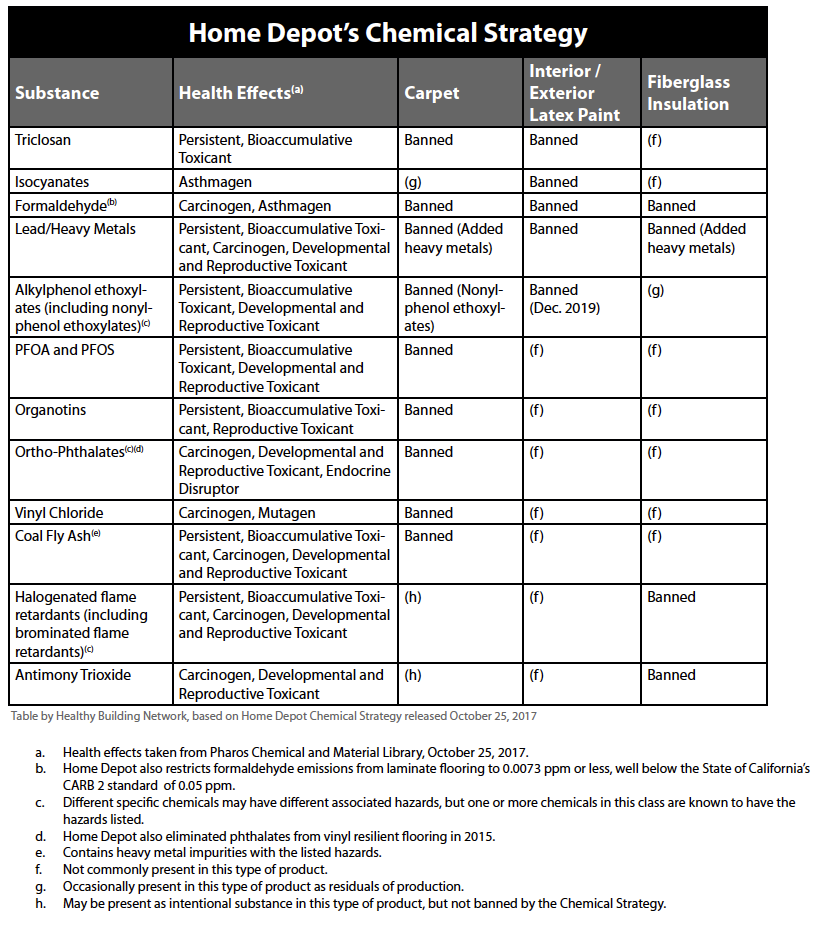

Home Depot’s most significant advances are in reducing toxic hazards in carpets and paints. The new carpet policy implements two major recommendations of HBN’s newest report, Eliminating Toxics In Carpet: Lessons For The Future of Recycling. published last week. As we reported, Shaw Industries – the country’s largest carpet manufacturer – recently stopped using fly ash from coal-fired power plants as filler. Today, Home Depot announced that fly ash, which contains toxic heavy metals, is “excluded from indoor wall-to-wall carpet in our U.S. and Canada stores.” Home Depot also announced its carpet does not contain several other chemicals that HBN has prioritized for elimination, including ortho-phthalates and organotins used in carpet backings.
Home Depot will also eliminate a class of toxic chemicals from paints called alkylphenol ethoxylates (APEOs). These chemicals, which are present even in low VOC paints, are surfactants, which help different types of material mix together well, and are coming under increased scrutiny as hormone disrupting chemicals with health effects ranging from breast cancer, reproductive disorders and obesity. They are mostly phased-out in Europe and Japan, but still common in the U.S., even though the EPA has identified over 200 “safer surfactants” to replace them.[2]
Today’s announcement is the next step on a long road that started with Home Depot’s 2015 move to eliminate phthalates from vinyl flooring. Much work lies ahead. For example, the company noted that it was not removing methylene chloride paint strippers from its shelves, a major objective of the national consumer campaign Mind The Store. The retailer’s hazard avoidance policy does not address some important problems even within the building product categories in its scope, and does not apply to many other high-impact building product categories. Regrettably, full public disclosure of all product ingredients is not required.
However, the hazard avoidance approach of the Home Depot Chemical Strategy signals fundamental, permanent and systemic improvement in the building products industry, and is a strong step towards health equity in building products. It leans toward a future when “healthy products” are not sold for a premium or as specialty items, and any product on the shelf meets the reasonable consumer expectations that it is healthy for people and our planet.
The Home Depot 2017 Responsibility Report can be found here:
https://corporate.homedepot.com/newsroom/infographic-2017-responsibility-report