
 READ HABITABLE’S NEW REPORT
Keep reading about similar topics.



Health
by Gina Zaitz Ciganik
 Health
Demand for safer chemistry is growing. Consumers are looking for ways to reduce hazard exposure, and choosing products with safer profiles. For companies, it’s become clear that hazardous chemicals can cost billions of dollars in lawsuits, fines, and loss of market share (see 3M’s $10.3B settlement over PFAS). This movement towards eliminating toxic chemicals comes at a time when the inadequacies of safety data sheets in communicating hazard information correctly and completely are coming to light.
As a result companies and researchers need an alternative tool to understand the hazards associated with the chemicals and materials in their products and in their supply chain. This tool needs to compile hundreds of data sources from across the globe and translate the hazard data in an easy to use format and be accessible to technical and non technical users. Luckily, there are researchers out there who have had the same problem, and developed a solution—a database that lets users quickly find reliable data on chemical hazards.
Pharos is a software application developed and managed by Habitable, a non-profit that uses science to advance green chemistry and healthier products. It’s used by researchers across industry, academia, and non-profits to speed up their search for safer chemicals.
Pharos gives you the information you need to compare chemicals, providing at-a-glance summaries about a chemical’s hazards, any data gaps, and how confident you should be in the knowledge. It saves time, saves money, derisks new product development, and helps avoid regrettable substitutions.
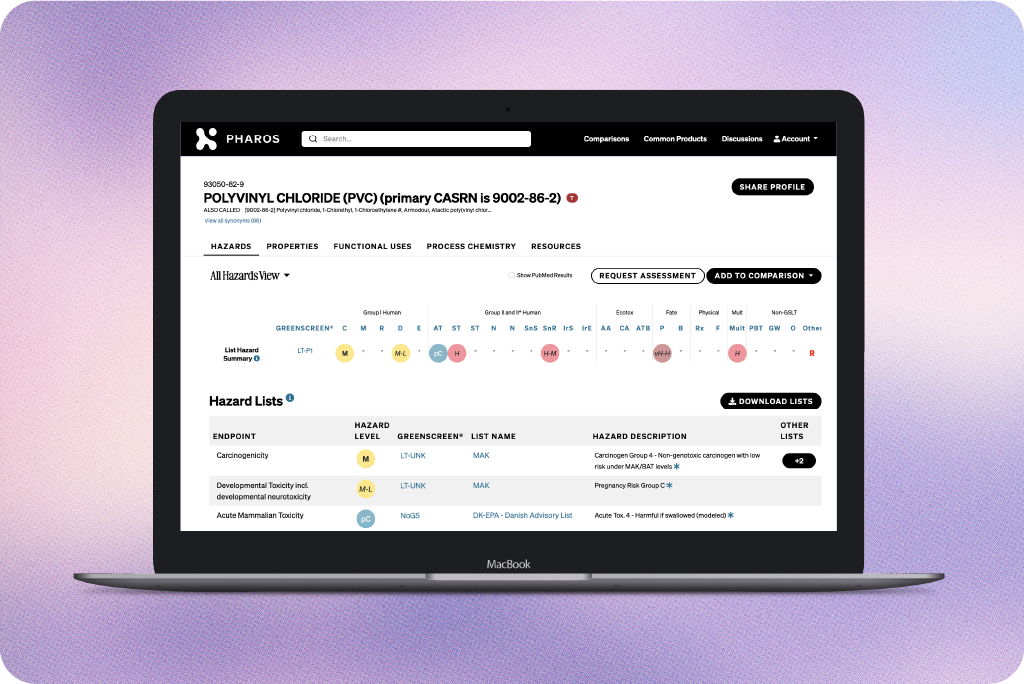
Pharos has been around in some form since 2006. Since then, it has saved countless hours for research teams working on safer chemistry projects. The Pharos API also allows the data to power tools like ChemForward, HPD Builder, and ChemHAT.
Pharos has data for over 200,000 chemicals, polymers, metals, and materials. Its broad usability means it’s used across sectors like cosmetics, cleaning products, building materials, electronics, and textiles.
Unlike the mess of technical PDFs you get when gathering your own data, Pharos presents information in an easy-to-read, downloadable format that allows you to directly compare chemicals.
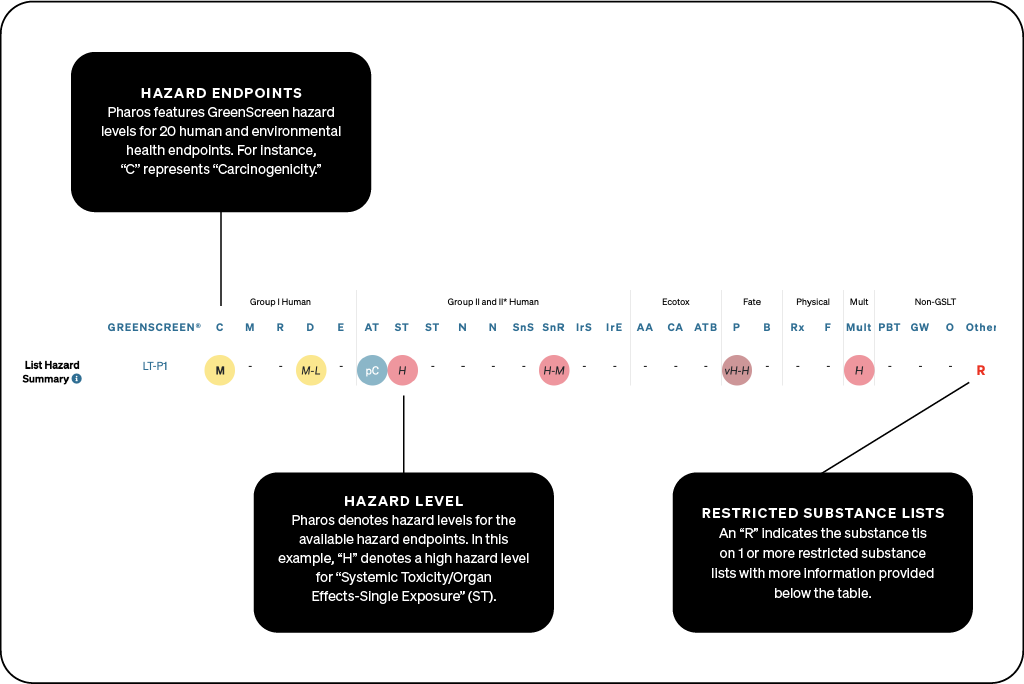
At the highest level, Pharos signals when a chemical is of high concern for human health or the environment using an easy to understand hazard ranking methodology. Pharos has long incorporated GreenScreen for Safer Chemicals (see text box for more information). It also supports the ChemFORWARD hazard bands which will be integrated into Pharos in the near future.
GreenScreen is a method developed by Clean Production Action to assess chemical hazard and help identify safer alternatives. It assigns chemicals a Benchmark score (from BM1 = “Avoid” to BM4 = “prefer”) based on their health and environmental hazard profiles.
GreenScreen List Translator is an abbreviated, automated screening method that checks whether a chemical appears on specific hazard lists. It assigns a score (LT-1 = “likely high concern”, LT-P1 = “Possibly high concern”, or LT-UNK “unknown concern”.
Habitable’s Pharos tool is a licensed GreenScreen List Translator Automator.
The data in Pharos is largely pulled from publicly available sources, like chemical regulations, restricted substances lists, and country specific inventories, ensuring transparency about where the data has come from.
The traffic light color coding gives an intuitive grasp of how hazardous a chemical is (red = bad, green = go), and you can immediately tell where the data gaps are, as well as potential concerns (pC) that aren’t well understood yet.
The strength of Pharos is that it combines multiple sources to get all the data it can about one chemical and translates that data into a single hazard level (“H” = high concern;) for a single hazard endpoint (like carcinogenicity). For example, formaldehyde is listed on California’s Prop 65 list as being known to cause cancer. It’s also on the European Union’s Annex VI list as a mutagen.
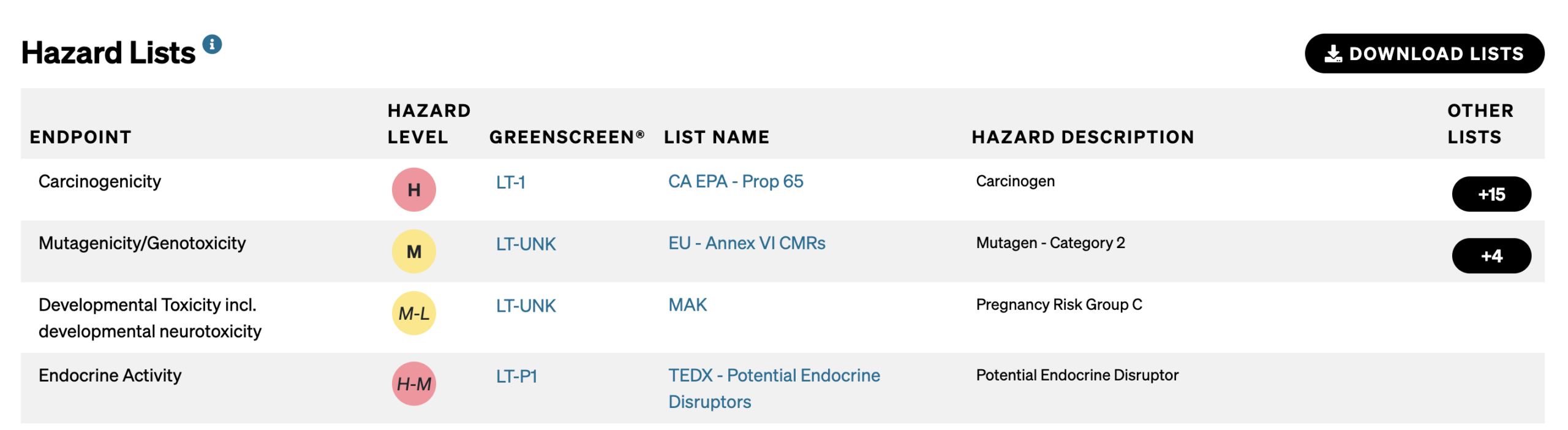
Many of these hazard level translations are defined by GreenScreen List Translator. See the GreenScreen Text box for more information.
Each source in the hazard table is clickable, and will take you to a clear explanation of what the source is, how it’s maintained, and links to the source itself, for maximum transparency.
Pharos also incorporates over 1000 GreenScreen assessments (some free, some purchasable), which are manual evaluations of chemical hazards performed by experienced toxicologists—they go deeper than the List Translator approach.
Despite all of the complicated information contained in it, Pharos is surprisingly easy to use. The researchers at Habitable have clearly put a lot of effort into making the tool accessible to anyone who wants to find safer chemicals.
First of all, the website has tutorials. Not a video! They are real tutorials actually built into the website, walking you through the tool and showing you where to click for a really smooth start.
Current tutorials:
The main interface is a simple, but powerful, search bar:

The Pharos search bar, showing that you can search for benzene, surfactant, or roofing as examples. You can search by chemical name, synonyms, CAS, by function, or by product type, which lets you use the tool flexibly. You can:
And if you want to talk to someone else about a chemical, you can do that in the forums and get answers from Habitable staff as well as other Pharos users.
So in short, Pharos is a valuable tool for anyone looking to research chemical hazards, and/or, design, or reformulate safer products. Habitable has made it very accessible by offering short- and long-term subscriptions, and multi-user discounts. Non-profits, government agencies, and academics can receive a discount on annual subscriptions.
So good luck on your journey towards safer chemistry, and try out Pharos for a day if you want to speed things up a bit!
Anna Zhenova is the CEO of Green Rose Chemistry, a mission-driven consultancy working to accelerate the sustainable chemical transition. She works with clients in industries ranging from fragrances to construction, bringing green chemistry out of the lab and into practical use.