
 READ HABITABLE’S NEW REPORT
Designing Out Plastics: A Blueprint for Healthier Building Materials
 Health
Chemistry underpins most of our modern world, from the agricultural chemistry that brings us food to the materials science that delivers homes, clothes, and energy. But when we train chemists, we do it with a curriculum that misses a critical need of modern chemists—understanding the human health and environmental impacts of the chemicals we use.
“My undergraduate chemistry course work never even mentioned chemical hazards.”
— Teresa McGrath, Chief Research Officer, Habitable
Students who go on to work in science, engineering, design, or policy need to understand chemical hazards in order to do their jobs responsibly, but any discussion of chemical hazards tends to be reserved for specialized electives like environmental chemistry, biochemistry, or toxicology. Habitable’s Pharos database fills this gap in modern chemistry education, while also making the concept accessible for other disciplines that make choices about materials.
Pharos is the industry’s most comprehensive, independent database on chemicals, polymers, metals and their associated human and environmental health hazards. It curates data on over 200,000 chemicals, using hundreds of authoritative sources, and translates the data into simple terms (like high, moderate or low concern) for 25 hazard traits (like carcinogenicity or bioaccumulation potential). Pharos teaches you to use it as you go, with tooltips to make new users comfortable, comparison tools, and even a discussion board for users. The result is a database that translates complex toxicological and regulatory data into a format that’s accessible even for non-experts—like students.
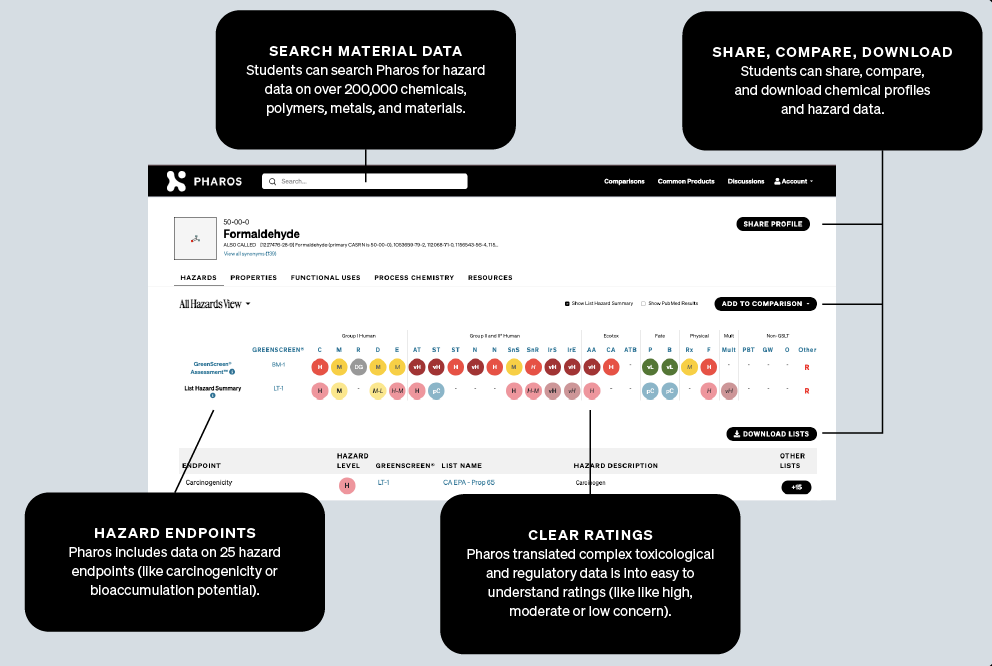
The ease with which Pharos can be picked up has led to scientific advances across a range of academic fields. It’s been cited hundreds of times in the academic literature, including studies on chemical exposure from building materials, surfactants for a PFAS-free floor polish, and safer lithium-ion batteries. With tools like a powerful search bar, sharing chemical comparisons, and the ability to download datasets, Pharos is a reliable research companion.
Maybe the most interesting benefit of all is that Habitable offers free scholarship access for academic researchers and students, making the tool affordable no matter what part of the world you’re in.
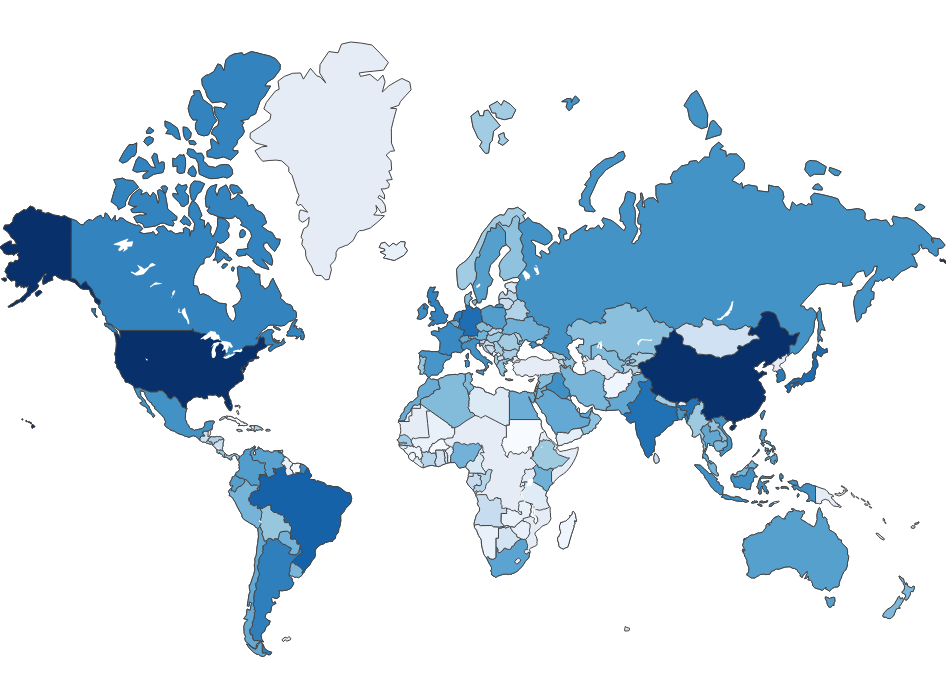
Scholarship access for faculty and students makes it possible to use Pharos in the classroom at no cost. Some universities, like UC Berkeley, have found Pharos so useful that they’ve partnered with Habitable to make Pharos available campus-wide through their library system.
Typical uses for Pharos in a classroom setting include comparing hazards in a chemical substitution, identifying safer building materials, analysing a product’s safety profile, and understanding impacts of chemical pollution. Students and staff have even used it to make lab assignments safer, evaluating the hazards of chemicals used in current undergraduate labs and proposing alternatives.
Including Pharos in a curriculum gives students hands-on experience in making chemical decisions the way they are made in industry, rather than treating safety as an abstract rule. Comparing substances side by side helps students connect chemical structures and properties to real-world impacts, building experience in evidence-based decision making as they explore, interpret data, and think critically about trade-offs.
At the Yale School of Environment, Pharos is being applied in a mixed undergraduate/graduate course, with student backgrounds ranging from chemistry to public health and environmental management. In this setting, Pharos first helps students to understand general toxicity concepts, then drill down into individual outcomes and hazards. Instructors have seen that students find it simple to grasp and assess knowledge on chemical compounds using Pharos, even without a toxicology background. The exercise intuitively introduces students to the concept of trade-offs in chemical decision making.
“Pharos has proven to be a very helpful tool in our Fundamentals of Green Chemistry and Green Engineering class, where students use systems thinking to identify and generate truly sustainable solutions”
— Dr. Hanno Erythropel, Yale University
Pharos is also being applied in the University of Washington’s online certificate program, which professionals join to upskill in green chemistry and chemical stewardship. Instructor Cathy Rudisill says, “Pharos helped my students obtain high quality, actionable chemical hazard assessment data, which is getting increasingly difficult to obtain outside of a paywall. Chemical hazard information from SDS’s are not ideal for making safer chemical decisions. The comparison feature of Pharos helps students do a direct comparison of the hazard tables, making it easy to see data gaps and trade-offs. I know the tool has an impact, because many students will apply the Pharos outputs to other assignments, even when it’s not a requirement.”
“[Pharos is] a comprehensive and practical resource that fits directly into our curriculum. Having access to a system like this is essential to completing the objectives of the course.”
— Cathy Rudisill, course instructor at University of Washington
At Algonquin College, a pioneering undergraduate course for interior design has students use Pharos to determine health risks of materials they are proposing to use in their studio projects. Instructor Bobby Ilg has found that Pharos “makes sense of chemicals for the non-chemist”.
As we transition from a petrochemical economy to a safer, greener chemical system, hazard literacy is becoming increasingly important. The curriculum for anyone training to work with chemicals or materials must change in order to prepare responsible scientists, engineers, and designers.
Pharos fills a critical gap in modern education for chemists as well as materials scientists, engineers, building scientists, and architects. The tool connects chemistry education and materials choices to real-world health impacts, engaging students with the consequences of chemical design without requiring a course in toxicology.
If you’d like to use Pharos in your classroom or research, fill out this form to request a Pharos scholarship.
Anna Zhenova is the CEO of Green Rose Chemistry, a mission-driven consultancy working to accelerate the sustainable chemical transition. She works with clients in industries ranging from fragrances to construction, bringing green chemistry out of the lab and into practical use.
HealthDemand for safer chemistry is growing. Consumers are looking for ways to reduce hazard exposure, and choosing products with safer profiles. For companies, it’s become clear that hazardous chemicals can cost billions of dollars in lawsuits, fines, and loss of market share (see 3M’s $10.3B settlement over PFAS). This movement towards eliminating toxic chemicals comes at a time when the inadequacies of safety data sheets in communicating hazard information correctly and completely are coming to light.
As a result companies and researchers need an alternative tool to understand the hazards associated with the chemicals and materials in their products and in their supply chain. This tool needs to compile hundreds of data sources from across the globe and translate the hazard data in an easy to use format and be accessible to technical and non technical users. Luckily, there are researchers out there who have had the same problem, and developed a solution—a database that lets users quickly find reliable data on chemical hazards.
Pharos is a software application developed and managed by Habitable, a non-profit that uses science to advance green chemistry and healthier products. It’s used by researchers across industry, academia, and non-profits to speed up their search for safer chemicals.
Pharos gives you the information you need to compare chemicals, providing at-a-glance summaries about a chemical’s hazards, any data gaps, and how confident you should be in the knowledge. It saves time, saves money, derisks new product development, and helps avoid regrettable substitutions.
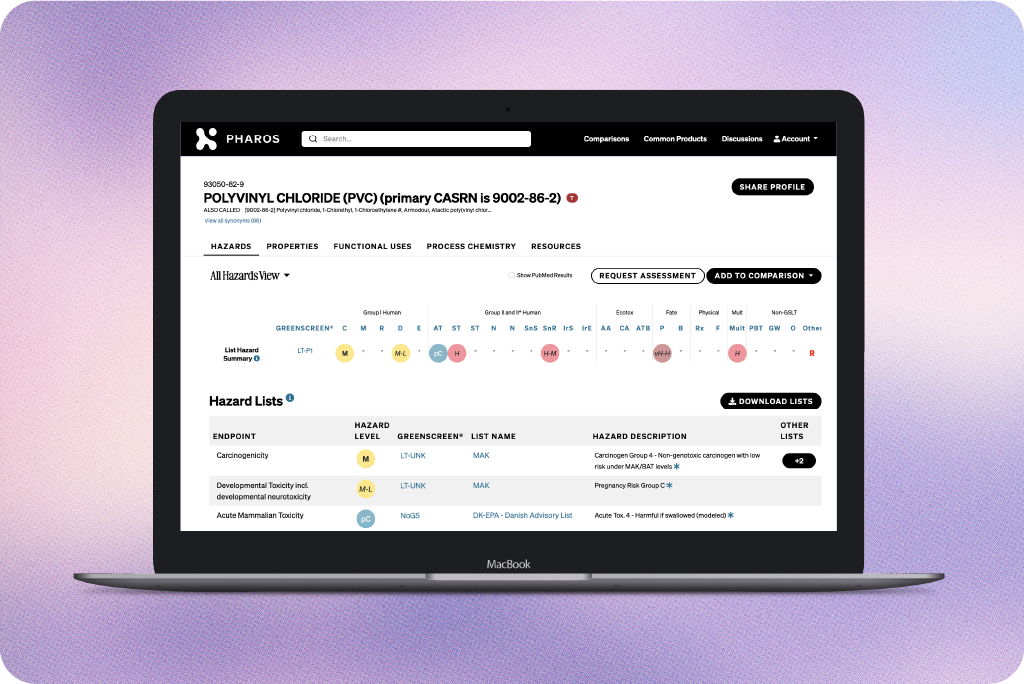
Pharos has been around in some form since 2006. Since then, it has saved countless hours for research teams working on safer chemistry projects. The Pharos API also allows the data to power tools like ChemForward, HPD Builder, and ChemHAT.
Pharos has data for over 200,000 chemicals, polymers, metals, and materials. Its broad usability means it’s used across sectors like cosmetics, cleaning products, building materials, electronics, and textiles.
Unlike the mess of technical PDFs you get when gathering your own data, Pharos presents information in an easy-to-read, downloadable format that allows you to directly compare chemicals.
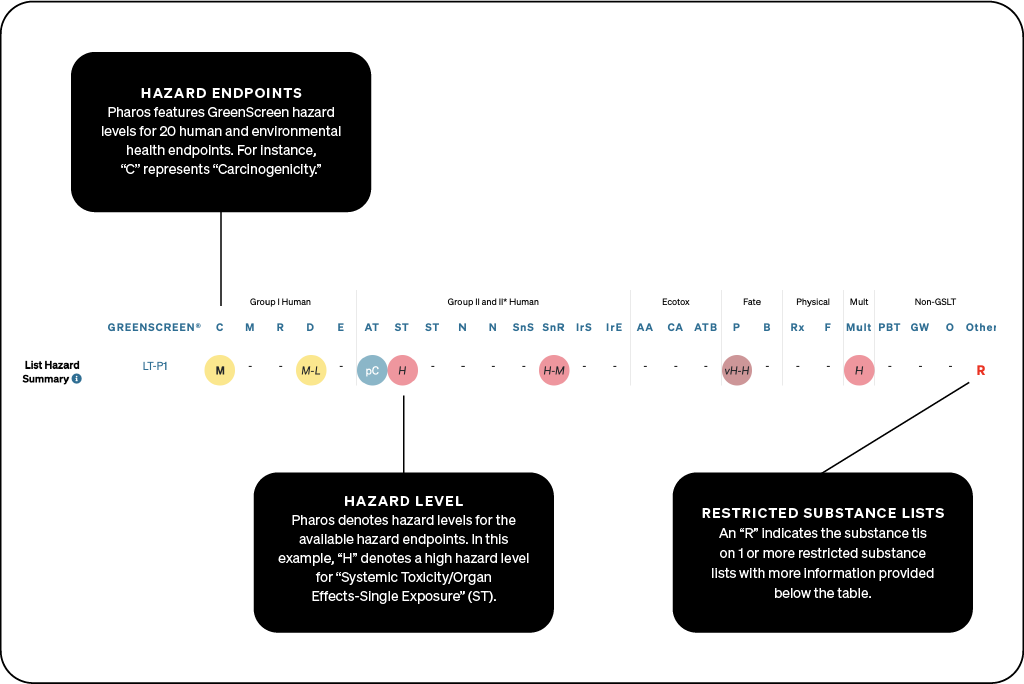
At the highest level, Pharos signals when a chemical is of high concern for human health or the environment using an easy to understand hazard ranking methodology. Pharos has long incorporated GreenScreen for Safer Chemicals (see text box for more information). It also supports the ChemFORWARD hazard bands which will be integrated into Pharos in the near future.
GreenScreen is a method developed by Clean Production Action to assess chemical hazard and help identify safer alternatives. It assigns chemicals a Benchmark score (from BM1 = “Avoid” to BM4 = “prefer”) based on their health and environmental hazard profiles.
GreenScreen List Translator is an abbreviated, automated screening method that checks whether a chemical appears on specific hazard lists. It assigns a score (LT-1 = “likely high concern”, LT-P1 = “Possibly high concern”, or LT-UNK “unknown concern”.
Habitable’s Pharos tool is a licensed GreenScreen List Translator Automator.
The data in Pharos is largely pulled from publicly available sources, like chemical regulations, restricted substances lists, and country specific inventories, ensuring transparency about where the data has come from.
The traffic light color coding gives an intuitive grasp of how hazardous a chemical is (red = bad, green = go), and you can immediately tell where the data gaps are, as well as potential concerns (pC) that aren’t well understood yet.
The strength of Pharos is that it combines multiple sources to get all the data it can about one chemical and translates that data into a single hazard level (“H” = high concern;) for a single hazard endpoint (like carcinogenicity). For example, formaldehyde is listed on California’s Prop 65 list as being known to cause cancer. It’s also on the European Union’s Annex VI list as a mutagen.
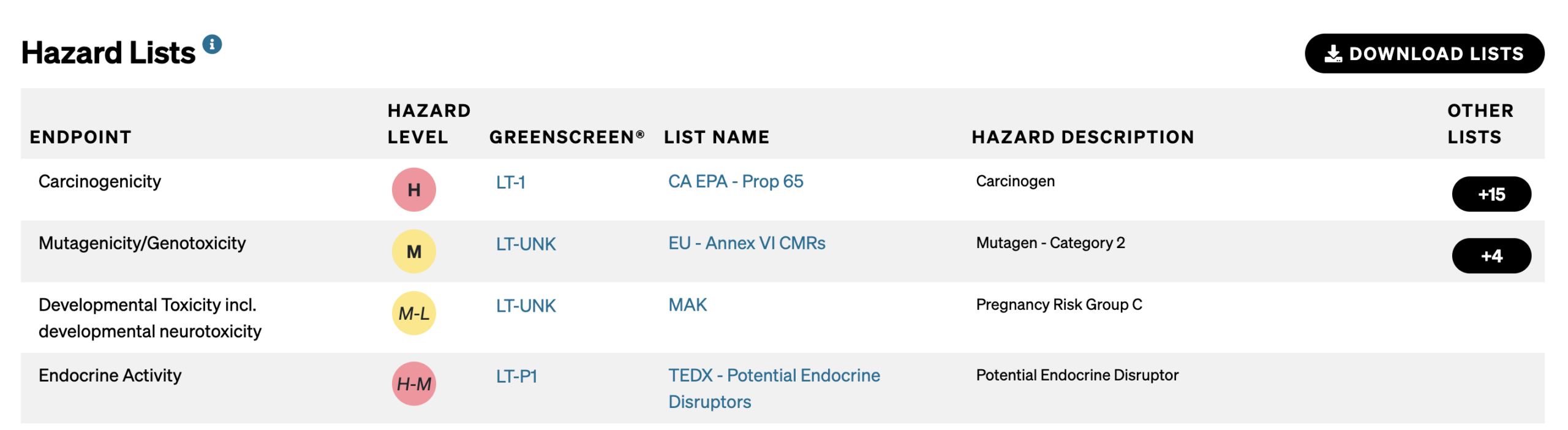
Many of these hazard level translations are defined by GreenScreen List Translator. See the GreenScreen Text box for more information.
Each source in the hazard table is clickable, and will take you to a clear explanation of what the source is, how it’s maintained, and links to the source itself, for maximum transparency.
Pharos also incorporates over 1000 GreenScreen assessments (some free, some purchasable), which are manual evaluations of chemical hazards performed by experienced toxicologists—they go deeper than the List Translator approach.
Despite all of the complicated information contained in it, Pharos is surprisingly easy to use. The researchers at Habitable have clearly put a lot of effort into making the tool accessible to anyone who wants to find safer chemicals.
First of all, the website has tutorials. Not a video! They are real tutorials actually built into the website, walking you through the tool and showing you where to click for a really smooth start.
Current tutorials:
The main interface is a simple, but powerful, search bar:

The Pharos search bar, showing that you can search for benzene, surfactant, or roofing as examples. You can search by chemical name, synonyms, CAS, by function, or by product type, which lets you use the tool flexibly. You can:
And if you want to talk to someone else about a chemical, you can do that in the forums and get answers from Habitable staff as well as other Pharos users.
So in short, Pharos is a valuable tool for anyone looking to research chemical hazards, and/or, design, or reformulate safer products. Habitable has made it very accessible by offering short- and long-term subscriptions, and multi-user discounts. Non-profits, government agencies, and academics can receive a discount on annual subscriptions.
So good luck on your journey towards safer chemistry, and try out Pharos for a day if you want to speed things up a bit!
Anna Zhenova is the CEO of Green Rose Chemistry, a mission-driven consultancy working to accelerate the sustainable chemical transition. She works with clients in industries ranging from fragrances to construction, bringing green chemistry out of the lab and into practical use.