
 READ HABITABLE’S NEW REPORT
Designing Out Plastics: A Blueprint for Healthier Building Materials
 Health
More than 15% of North Americans report an unusual hypersensitivity to common chemical products such as those used in new-home construction. Another 40% may have mild symptoms of which they’re unaware.
This book explores the journey of designing and building a prototype healthy house, aiming to provide a sanctuary for healing and addressing environmental hypersensitivity, serving as a comprehensive guide for those interested in healthier approaches to design, construction, or remodeling.
 Health
Circular design encourages us to rethink business models and how we make products, and to consider the systems surrounding them. But we also need to think about the materials we use – and the chemistry behind them.
To create a truly sustainable circular economy, we must know what’s in the materials and products we choose, and those choices should focus on optimized chemistry for human and environmental health. Only then will we have the building blocks for a circular economy.

A circular economy is fueled by the creation and retention of value. By keeping material streams as pure as possible from the beginning and through the entire use cycle, the full value of a material is retained. Value retention is key to activating the systems that make the circular economy function, including the incentive for manufacturers to take back products because they have value and the motivation for entrepreneurs to create robust secondary markets.
Not all materials are fit for a circular economy, however. When they contain chemicals that are hazardous for humans or the environment, they provide little to no value in supporting circularity. Fortunately there are ways to choose materials that are safe AND circular so you can build a better offering for your users and introduce valuable inputs for a sustainable economy.
To help designers, entrepreneurs, and innovators make positive materials choices and integrate better chemistry into the design process from the very start, the Ellen MacArthur Foundation and the Cradle to Cradle Products Innovation Institute (C2C PII) have released a new series of advanced learning modules as part of the foundation’s Circular Design Guide, which was co-created with IDEO.
You’ll find them in the Methods section of the guide (scroll to the “Advanced” section), which aims to fuel design thinking for the circular economy by challenging traditional design methods, delivering new approaches, and introducing users to circular economy concepts as well as techniques updated for this new economic framework.

Check out Safe & Circular by Design: Making Positive Material Choices, a podcast hosted by Emma Fromberg from the Ellen MacArthur Foundation and featuring Stacy Glass, director of ChemFORWARD, alongside other leaders in the safe and circular movement.
HealthThe Home Depot Chemical Strategy, included in its 2017 Responsibility Report, targets a range of chemicals known or suspected to cause cancer, mimic and disrupt hormone systems, and impair brain function. The retailer’s policies, for certain product categories, far exceed the chemical restrictions of LEED and most product certifications in these categories. The world’s largest retailer of building products credited HBN’s “guidance on priority chemicals and innovation” as it adopted many of the recommendations made by HBN and other environmental health groups in a dialogue begun in 2014.
By applying its chemical strategy to all products in target categories, Home Depot makes important strides toward equity in the green building movement. It tracks many of the recommendations HBN provides to the affordable housing community in our HomeFree initiative. Because it impacts products at all price points, not just premium products and not just those that qualify for the retailer’s Eco-Options program, the policy ensures that all contractors and do-it-yourself customers get healthier products regardless of the brand purchased, and regardless of whether or not the product has been certified “green.” One of the qualifying products, a flat sheen paint, is the first “zero VOC” paint priced under $20 per gallon.[1] “We’re not just sourcing new healthier products, we are striving to improve our current assortment of the products we already sell,” Ron Jarvis, Home Depot Vice President of Merchandising and Sustainability, told HBN.
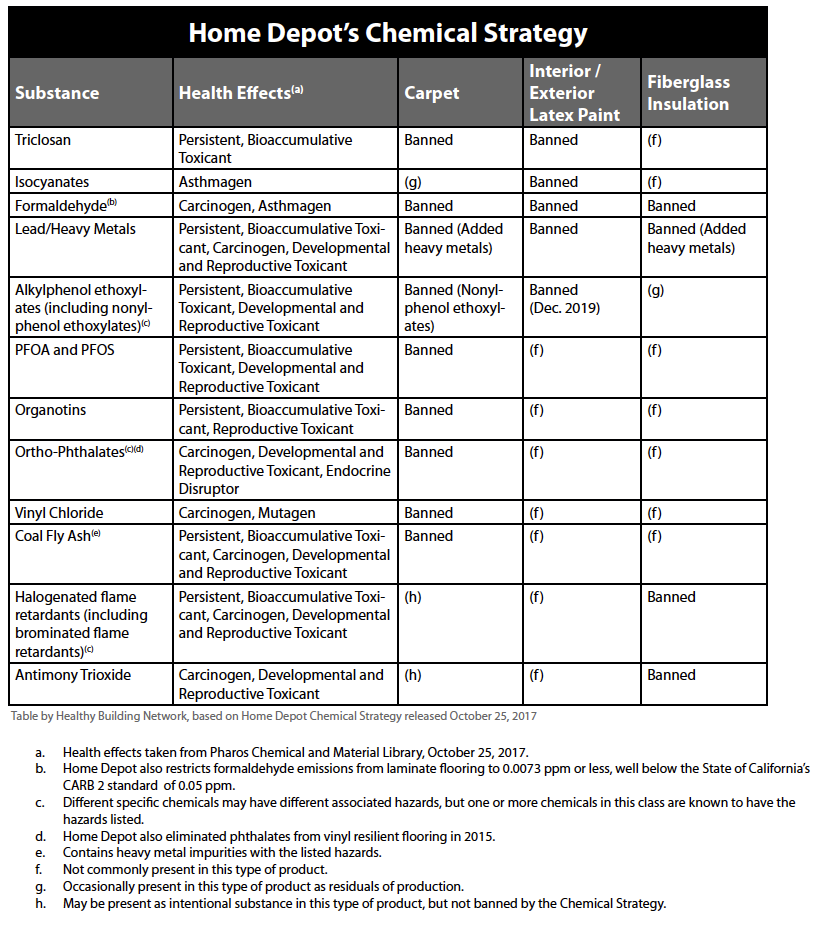

Home Depot’s most significant advances are in reducing toxic hazards in carpets and paints. The new carpet policy implements two major recommendations of HBN’s newest report, Eliminating Toxics In Carpet: Lessons For The Future of Recycling. published last week. As we reported, Shaw Industries – the country’s largest carpet manufacturer – recently stopped using fly ash from coal-fired power plants as filler. Today, Home Depot announced that fly ash, which contains toxic heavy metals, is “excluded from indoor wall-to-wall carpet in our U.S. and Canada stores.” Home Depot also announced its carpet does not contain several other chemicals that HBN has prioritized for elimination, including ortho-phthalates and organotins used in carpet backings.
Home Depot will also eliminate a class of toxic chemicals from paints called alkylphenol ethoxylates (APEOs). These chemicals, which are present even in low VOC paints, are surfactants, which help different types of material mix together well, and are coming under increased scrutiny as hormone disrupting chemicals with health effects ranging from breast cancer, reproductive disorders and obesity. They are mostly phased-out in Europe and Japan, but still common in the U.S., even though the EPA has identified over 200 “safer surfactants” to replace them.[2]
Today’s announcement is the next step on a long road that started with Home Depot’s 2015 move to eliminate phthalates from vinyl flooring. Much work lies ahead. For example, the company noted that it was not removing methylene chloride paint strippers from its shelves, a major objective of the national consumer campaign Mind The Store. The retailer’s hazard avoidance policy does not address some important problems even within the building product categories in its scope, and does not apply to many other high-impact building product categories. Regrettably, full public disclosure of all product ingredients is not required.
However, the hazard avoidance approach of the Home Depot Chemical Strategy signals fundamental, permanent and systemic improvement in the building products industry, and is a strong step towards health equity in building products. It leans toward a future when “healthy products” are not sold for a premium or as specialty items, and any product on the shelf meets the reasonable consumer expectations that it is healthy for people and our planet.
The Home Depot 2017 Responsibility Report can be found here:
https://corporate.homedepot.com/newsroom/infographic-2017-responsibility-report
Health
Healthy Building Network’s report on post-consumer carpet feedstocks calls for eliminating over 40 highly toxic chemicals in carpets that threaten public health and impede recycling. These toxics are known to cause respiratory disease, heart attacks, cancer, and asthma, and impair children’s developmental health.
The report outlines strategies to protect public health and the environment by improving product transparency, eliminating dangerous chemicals from carpets, and increasing carpet recycling rates. It also reveals surprising efforts in the industry to remove many of these toxic substances from carpet design.
Health
Building products incorporating antimicrobial additives are becoming increasingly prevalent. Paints, and other touchable surfaces such as countertops, and virtually any product considered as an interior finish may contain one or a combination of antimicrobials. These agents are considered pesticides, but their identity—and related hazards—can be difficult for the average person to discover. This lack of transparency creates a hurdle for the informed selection of products with reduced negative impacts.
No evidence yet exists to demonstrate that products intended for use in interior spaces that incorporate antimicrobial additives actually result in healthier populations. Further, antimicrobials may have negative impacts on both people and the environment. This paper, prepared by Perkins&Will in partnership with HBN, aims to present current information about reported or potential health and environmental impacts of antimicrobial substances as commonly used within the building industry, and to assist architects, designers, building owners, tenants, and contractors in understanding those impacts.
In response to growing concerns over COVID-19, Healthy Building Network (HBN) and global architecture and design firm Perkins and Will reexamined and reaffirmed the conclusions and recommendations of this white paper.
HealthResearch from Healthy Building Network (HBN) documents how vinyl building products, also known as PVC or polyvinylchloride plastic, are the number one driver of asbestos use in the US.
The vinyl/asbestos connection stems from the fact that PVC production is the largest single use for industrial chlorine, and chlorine production is the largest single consumer of asbestos in the US. [1] More than 70% of PVC is used in building and construction applications – pipes, flooring, window frames, siding, wall coverings and membrane roofing. [2] This makes the building and construction industry the single largest product sector consuming chlorine, bearing sizeable responsibility for the ongoing demand for asbestos. [3]
Despite the existence of asbestos (and mercury) free chlorine production methods, the PVC industry has positioned itself at the vanguard of industry efforts to frustrate stronger asbestos regulation. According to Mike Belliveau, the Executive Director of the Environmental Health Strategy Center and a senior advisor to Safer Chemicals Healthy Families coalition, “The PVC market has spurred chemical industry lobbyists to urge the Trump Administration to exempt their use of deadly asbestos from future restrictions.” The last time the vinyl industry positioned themselves so publicly on the other side of common sense, they were defending the use of lead in children’s vinyl lunch boxes.

The health hazards of asbestos exposure, painful and deadly lung diseases including cancer, are clear. Green building professionals do not have to wait. Do your part to prevent asbestos-related diseases here and abroad. Don’t specify vinyl building products.
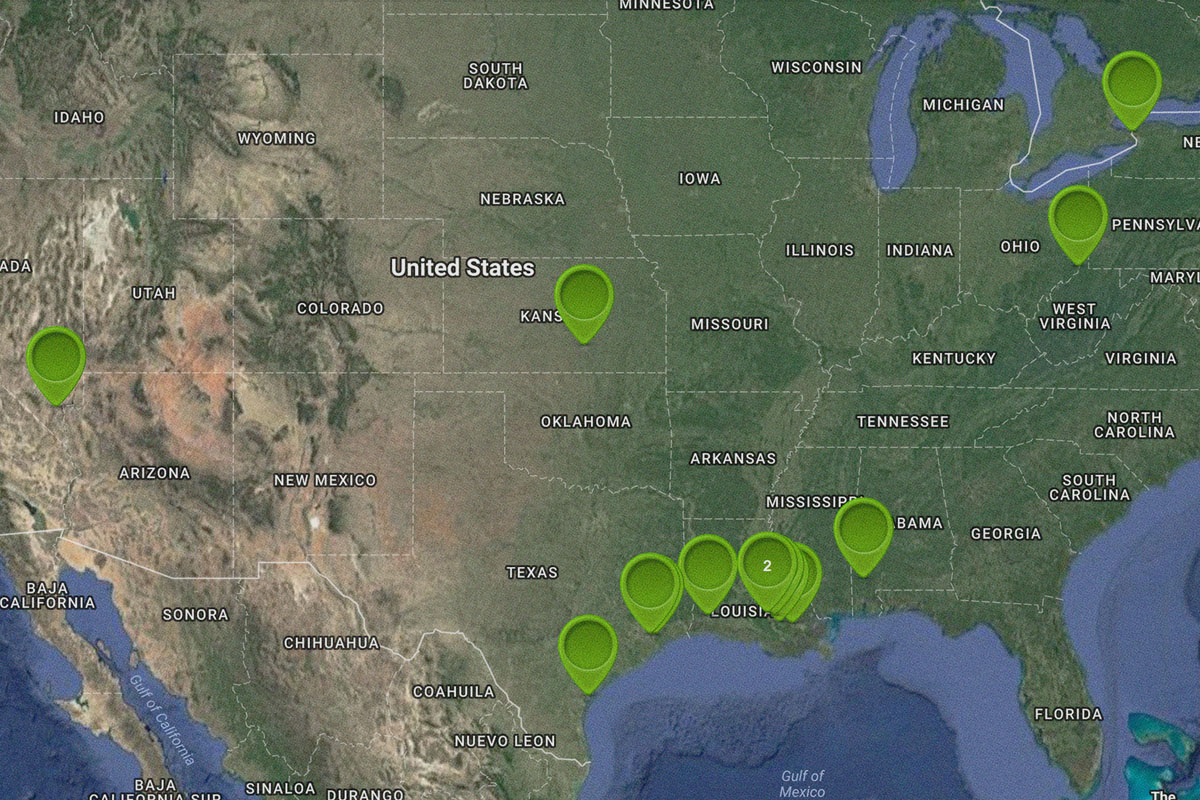
1. In the US more than half of chlorine is produced using asbestos, despite the availability of an alternative production method that does not require either asbestos or mercury.
2. http://www.vinylinfo.org/vinyl/uses
3. According to IHS Markit, “A majority of chlor-alkali capacity is built to supply feedstock for ethylene dichloride (EDC) production. EDC is then used to make vinyl chloride (VCM) and subsequently used to manufacture polyvinyl chloride (PVC). This chain, EDC to VCM to PVC, is normally called the vinyl chain. PVC demand correlates closely with construction spending, therefore, it can be concluded that chlorine consumption and production are driven by the construction industry. Hence, chlorine consumption growth depends on the growth of the global economy, since a country will spend more on construction if it has a healthy gross domestic product.” (IHS Markit. “Chemical Economics Handbook: Chlorine/Sodium Hydroxide (Chlor-Alkali),” December 2014. https://www.ihs.com/products/chlorine-sodium-chemical-economics-handbook.html)
4. Fifteen chlor-alkali plants last reported to be using asbestos diaphragms include, in order of estimated chlorine capacity:
5. Carpentier, Steve. “Minaçu, a cidade que respira o amianto.” CartaCapital, May 21, 2013. http://www.cartacapital.com.br/sustentabilidade/minacu-a-cidade-que-respira-o-amianto-8717.html
Health
Healthy Building Network’s research into current recycling practices for flexible polyurethane foam (FPF) indicates that most post-consumer feedstocks are contaminated with highly toxic flame retardants.
Discussions of recycling FPF have centered around the human health and environmental hazards posed by the flame retardant PentaBDE, which the foam industry phased out a decade ago. But the flame retardants that have replaced PentaBDE present similar concerns. Manufacturers incorporate flame retardant-laden post-consumer FPF into new products, primarily bonded carpet cushion. Recycling and installation workers and building occupants, particularly crawling children, can be exposed to these toxic chemicals. The recent emergence of pre-consumer FPF scrap that is free of flame retardants is a great step toward a safer, more valuable feedstock, but more work is needed to track and label flame retardant-free FPF to ensure that future post-consumer foam is also flame retardant-free.
Health
Polyethylene is the world’s most common plastic. It is used in packaging, food and beverage containers, and consumer products.
Building product manufacturers sometimes use post-consumer recycled polyethylene bags and bottles in pipes and plastic lumber. This scrap usually has minimal contents of concern, but products like detergents stored in plastic packaging can remain. So-called “bio-degradation” agents in plastic bags also contaminate this feedstock and should never be used. The plastics recycling industry is developing protocols to screen out residual contaminants. Of greatest concern: Most polyethylene goes unrecycled in the United States due to problems in supply chain controls and the low price of virgin resins. This report examines ways to optimize the use of post-consumer polyethylene in building materials.
Health
The recycling industry has made significant strides toward a closed loop material system in which the materials that make up new products today will become the raw material used to manufacture products in the future. However, contamination in some sources of recycled content raw material (“feedstock”) contain potentially toxic substances that can devalue feedstocks, impede growth of recycling markets, and harm human and environmental health.
Since May 2014, the Healthy Building Network, in collaboration with StopWaste and the San Francisco Department of Environment, has been evaluating 11 common post-consumer recycled-content feedstocks used in the manufacturing of building products. This paper is a distillation of that larger effort, and provides analysis on two major feedstocks found in building products: recycled PVC and glass cullet. This research partnership seeks to provide manufacturers, purchasers, government agencies, and the recycling industry with recommendations for optimizing the use of recycled content feedstocks in building products in order to increase their value, marketability and safety. This report was prepared in support of a research session at the 2015 Greenbuild conference in Washington, DC.
Health
New HBN research reveals that legacy toxic hazards are being reintroduced into our homes, schools and offices in recycled vinyl content that is routinely added to floors and other building products. Legacy substances used in PVC products, like lead, cadmium, and phthalates, are turning up in new products through the use of cheap recycled content.
Funding for research on post-consumer PVC feedstock was provided by StopWaste and donors to the Healthy Building Network (HBN). It was conducted using an evaluative framework to optimize recycling developed by StopWaste, the San Francisco Department of the Environment, and HBN. This briefing paper on post-consumer recycled PVC is a prequel to a forthcoming white paper by this new collaboration.