
 READ HABITABLE’S NEW REPORT
Designing Out Plastics: A Blueprint for Healthier Building Materials
 Health
Pharos makes it easier than ever to prioritize chemicals management and identify safer alternatives to chemicals of concern. We’re excited to share several resources to help shape the next generation of green chemistry leaders:

Educators are doing important work and making our homes, workplaces and communities safer to inhabit. Pharos can help you meet your goals and streamline your work. In addition to our standard online access, now there are more ways to access chemical hazard data!
If you are interested in further details, or subscribing to Pharos, more information is available here.
 Pollution
ChemSec’s Marketplace connects products like this car seat with safer alternatives to hazardous chemicals, offering a platform for them to find better matches and reduce their environmental impact.
Pollution
Phase 2 of this report is the first of its kind plant-by-plant accounting of the production, use, and releases of chlorine and related pollution around the world. It is intended to inform the efforts of building product manufacturers to reduce pollution in their supply chains.
Chlorine is a key feedstock for a wide range of chemicals and consumer products, and the major ingredient of polyvinyl chloride (PVC) plastic. The report includes details aboutthe production technologies used and markets served by 146 chlor-alkali plants (60 in Asia) and which of these plants supply chlorine to 113 PVC plants (52 in Asia). The report answers fundamental questions like:
Key findings include:
Supplemental Documents:
Pollution
The Global Chemicals Outlook II assesses global trends and progress in managing chemicals and waste to achieve sustainable development goals, with a focus on innovative solutions and policy recommendations.
HealthThank you to Positive Energy’s Building Science podcast for hosting Habitable’s Gina Ciganik, CEO, and Billy Weber, Collective Impact Director, to discuss our resources and work towards healthier building products.
HealthFor years, Habitable has been thinking about and consulting with our partners about how to describe the impact of choosing healthier building products. Here’s why this is a complex and challenging issue for the industry:
These reasons drive the need for full transparency of chemical contents and full assessment of chemical hazards. This can ultimately lead to optimizing products in order to avoid hazardous chemicals.
Toxic chemicals have a huge and complex impact on the health and well-being of people and the environment. Those impacts are spread throughout a product’s life cycle. For example, fenceline communities can be exposed during the manufacturing of products in adjacent facilities, workers can be exposed on the job during the manufacturing and installation processes, and building occupants can be exposed during the product’s use stage. Some individuals suffer multiple exposures because they are affected in all of those instances.
In addition, toxic chemicals can be released when materials are disposed of or recycled. When they incorporate recycled content into new products, manufacturers can include legacy toxicants, inhibiting the circular economy and exposing individuals to hazardous chemicals—even those that have been phased out as intentional content in products.
We know intrinsically that hazardous chemicals have the potential to do harm and that they commonly do so. For champions of this cause, that understanding of the precautionary principle is enough. Others still need to be convinced and often want to quantify the impact of a healthy materials program. How can healthy building champions start to talk about and quantify the impacts of material choices?

Broad Impacts of Toxic Chemicals
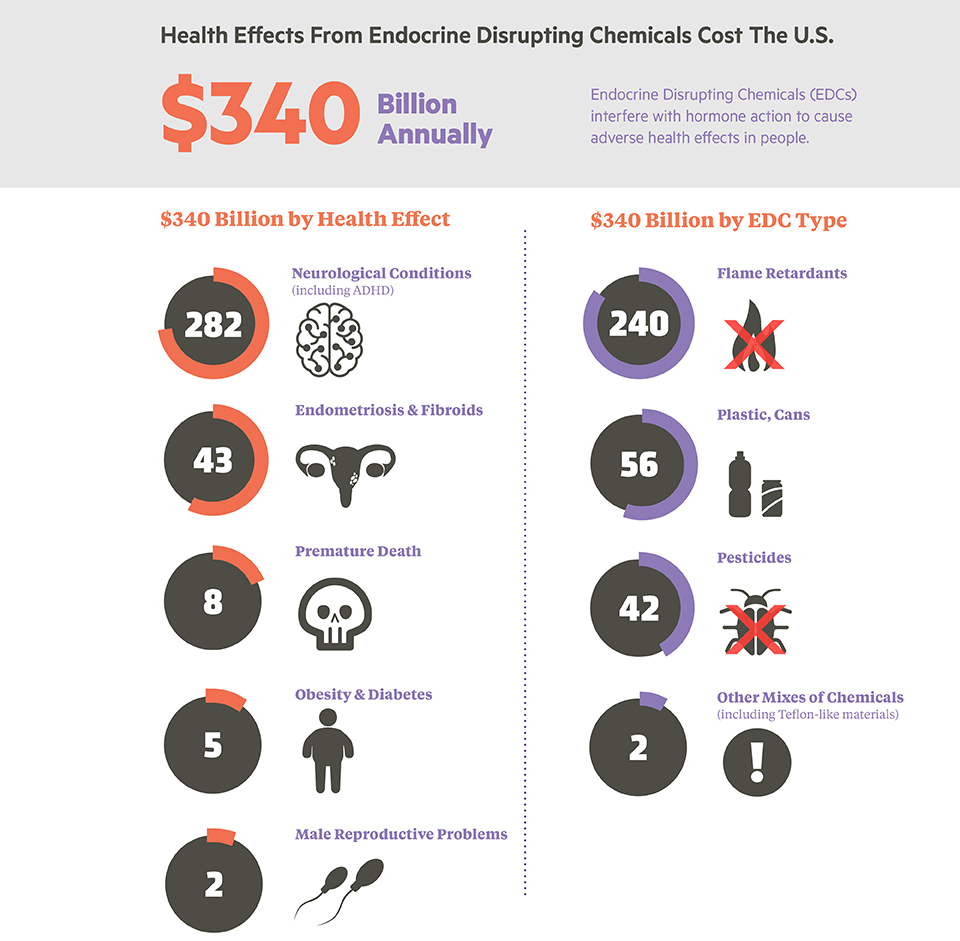
One way researchers quantify the impact of chemicals is to consider the broad economic impacts of chemical exposures. Evidence increasingly shows that toxic chemical exposures may be costing the USA billions of dollars and millions of IQ points. One recent study estimates that certain endocrine-disrupting chemicals cost the United States $340 billion each year. This is a staggerring 2.3% of the US gross domestic product.1 And that is for only a subset of the hazardous chemicals that surround us every day. These numbers provide important context for the larger discussion of toxic chemical use, but cannot easily be tied to daily decisions about specific materials.
Market Scale Impacts
For years, Habitable has been targeting orthophthalates in vinyl flooring as a key chemical and product category combination to be avoided. Orthophthalates can be released from products and deposited in dust which can be inhaled or ingested by residents—particularly young children who crawl on floors and often place their hands in their mouths3. By systematically reducing chemicals of concern in common products, we can all work together to continue to affect this scale of change in the marketplace and keep millions more tons of hazardous chemicals out of buildings.
Impacts on the Project Scale
Context is key for understanding the impact chemical reduction or elimination can have—a pound of one chemical may not have the same level of impact as a pound of another chemical. But, given the right context, this sort of calculation may prove useful as part of a larger story. The following examples provide context for the story of different impacts of different chemicals.
In addition to information about target chemicals to avoid, our Informed™ product guidance provides recommendations of alternative types of materials that are typically better from a health hazard perspective and includes steps to work toward the goal of full transparency of product content and full assessment of chemical hazards. This framework can help ensure that toxic chemicals and regrettable substitutions are avoided.
Each decision you make about the materials you use, each step toward using healthier products, can have big impacts within a housing unit, a building, and in the broader environment. Collectively, these individual decisions also influence manufacturers to provide better, more transparent products for us all. Ultimately, this can reduce the hazardous chemicals not just in our buildings but also in our bodies.
 Climate Change
Some people can probably name a chemical that contributes to climate change, whether that is carbon dioxide or methane. But what about other chemicals that you are not as familiar with? In the building materials world, these may include fluorinated blowing agents used in some foam insulation. The agents either have high global warming potential (GWP) or use chemicals in their production that have high GWP.1 Another example is the release of the toxic, global warming, and ozone-depleting chemical carbon tetrachloride in the enormous supply chain of vinyl products, otherwise known as poly vinyl chloride (PVC).2 Purveyors of vinyl products, you may unwittingly be contributing to global warming!
Yes, the way in which certain chemicals contribute to climate change is important, but this interplay is not the only consequence of chemicals on our climate. Climate change is also altering how toxic chemicals impact our health and the health of the environment – as the world warms, reducing our exposure to toxic chemicals becomes ever more important.

While most toxic chemicals do not cause climate change, they do affect how climate change might impact you. These impacts compound as more chemicals are produced or utilized.15 In 1970, the U.S. produced 50 million tons of synthetic chemicals.16 In 1995, the number tripled to 150 million tons, and today, that number continues to increase.17
Very few of the tens of thousands of chemicals on the marketplace are fully tested for health hazards, and details on human exposure to these chemicals are limited.18 We are exposed to these chemicals every day, in varying quantities and mixtures. Over a lifetime, the small exposures add up. Predictions of health outcomes from long-term exposure are already fuzzy at best, but add on the component of climate change and the mystery deepens.19 While researchers continue to study climate change and chemicals to answer the questions we have, there are steps that we can take to help mitigate the negative impact of climate change on chemicals.
Habitable’s Small Piece of the Pie — How We’re Keeping Consumers Safe
We cannot remove all chemicals from our lives and many play important roles, but, we can follow the precautionary principle. If there is a less toxic chemical or product available that meets our requirements, we should use it. At Habitable, our work is guided by the precautionary principle—otherwise known as ‘better to be safe than sorry.’ Our chemical and product guidance provides advice on better products.Empowering industry to choose safer chemicals and products helps reduce the burden of toxic chemicals on all people and the planet – especially our most vulnerable populations.
Why We Can and Must Do Better
Between climate change and toxic chemicals, it could be easy to push toxic chemicals to the side as a someday problem and choose to tackle climate change first. But the truth is that the impacts of toxic chemicals are real and happening today and will only get worse in a warming world. These two issues are connected and influence each other’s outcomes. Climate change is having a significant impact on our world, but prioritizing reduction of toxic chemicals can reduce the negative consequences that climate change will have on chemicals, and consequently on us.
Climate ChangeIt is critical that these efforts align their goals lest, once again, the latest definition and marketing of “green” building products overlooks and overrides the interests of the front line communities most impacted by both climate change and toxic pollution.
The Carbon Leadership Forum describes embodied carbon as “the sum impact of all the greenhouse gas emissions attributed to the materials throughout their life cycle (extracting from the ground, manufacturing, construction, maintenance and end of life/disposal).2 In a widely praised book, The New Carbon Architecture3, Bruce King explains clearly why reducing carbon inputs to building materials immediately—present day carbon releases—is more effective at meeting urgent carbon reduction goals than the gains of even a Net Zero building, which are realized over decades. This approach is embraced by the Materials Carbon Action Network, a growing association of manufacturers and others, which states as its aim “prioritization of embodied carbon in building materials.”(emphasis added).4
Climate action priorities are framed differently by groups at the forefront of movements for climate justice and equity in the green building movement. Mary Robinson, past President of Ireland, UN High Commissioner on Human Rights and UN Special Envoy on Climate Change, says climate justice “insists on a shift from a discourse on greenhouse gases and melting ice caps into a civil rights movement with the people and communities most vulnerable to climate impacts at its heart.” 5 The Equitable and Just National Climate Platform6, adopted by a broad cross section of environmental justice groups and national organizations including Center for American Progress, League of Conservation Voters, Natural Resources Defense Council, and Sierra Club, calls for “prioritizing climate solutions and other policies that also reduce pollution in these legacy communities at the scale needed to significantly improve their public health and quality of life.” The NAACP’s Centering Equity In The Sustainable Building Sector (CESBS)7 initiative advocates “action on shutting down coal plants and other toxic facilities at the local level, as well as building of new toxic facilities, with advocacy to strengthen development, monitoring, and enforcement of regulations at federal, state, and local levels. Also includes a focus on corporate responsibility and accountability.”8

The embodied carbon and climate justice initiatives are aligned when carbon reductions in building products are achieved through industrial process changes that reduce the use of fossil fuels and other petrochemicals. But rarely, if ever, can building products be manufactured with no carbon footprint, i.e. without fossil fuel inputs. These initiatives may not be aligned when manufacturers promote “carbon neutral” or “carbon negative” products that rely on carbon trading or offsets, the practice of supporting carbon reduction elsewhere (by planting trees or investing in renewable energy) to offset fossil fuel and petrochemical inputs at the factory. According to the Equitable and Just National Climate Platform: “ . . . these policies do not guarantee emissions reduction in EJ communities and can even allow increased emissions in communities that are already disproportionately burdened with pollution and substandard infrastructure.” They may also allow increased toxic pollution, if a manufacturer chooses to invest in carbon offsets, for example, rather than invest in process changes that reduce toxic chemical use or emissions. As a result, disproportionate impacts, often correlated with race, can be perpetuated.
Vinyl provides one example of such inequity. Vinyl’s carbon footprint includes carbon tetrachloride, a chemical released during chlorine production that is simultaneously highly toxic, ozone depleting, and a global warming gas 1,400 times more potent than CO2. Offsetting these releases with tree planting or renewable energy purchases does nothing for the toxic fallout, from carbon tetrachloride, fossil fuels and other petrochemicals, on the communities adjacent to those manufacturing facilities.
Experts agree that the most embodied carbon reductions by far are to be had in addressing steel and concrete in buildings. Beyond that, experts disagree about the strength of the data available to track carbon reductions and compare products in a meaningful, objective way, and warn of diminishing returns relative to the investment needed to track carbon in every product. These may prove to be worth pursuing, but not at the expense of meaningful improvements to conditions in fenceline communities.
Habitable believes that these approaches can be reconciled and aligned through dialogue that includes the communities most impacted by the petrochemical infrastructure that is driving climate change. Our chemical hazard database, Pharos, and our collaboration with ChemFORWARD provide manufacturers with the ability to reduce their product’s carbon and toxic footprints.
We can in good faith pursue reductions in embedded carbon and toxic chemical use, climate and environmental justice and to define climate positive building products accordingly. Prioritizing selection of products simply upon claims of carbon neutrality, however, is not yet warranted.
HealthHome Depot, the world’s largest home improvement retailer, announced Sept. 17 that it will phase out the sale of all carpets and rugs containing PFAS chemicals, expanding the reach of its Chemical Strategy adopted in 2017.
The company said it will stop purchasing for distribution in the U.S., Canada and online any carpets or rugs containing PFAS chemicals by the end of 2019. The new policy has important implications beyond reducing the use of these chemicals, which are associated with serious health harm and last virtually forever in the environment.
Environmental justice & equity: As with the 12 chemicals banned under its original 2017 Chemicals Strategy, this policy makes important strides toward equity in the green building movement. Because it impacts products at all price points, not just premium products and not just those that qualify for the retailer’s Eco-Options program, the policy ensures that all contractors and do-it-yourself customers get healthier products regardless of the brand purchased, and regardless of whether or not the product has been certified “green.” This makes it easier to implement recommendations such as those Habitable provides through our Informed™ approach.

Market Influence
A similar policy change led by the retailer in 2015, banning phthalates from all vinyl flooring it sells, was quickly adopted by all other major retailers such as Lowes, Menards, and Lumber Liquidators. Similarly, when Lowes led the industry in banning the sale of deadly paint strippers in May, 2018, its major competitors followed suit within months
Class approach to chemicals
PFAS refers to a class of nearly 15,000 that repel liquids and resist sticking, including well-known brands such as Teflon, Gore-Tex, Stainmaster and Scotchgard. Many brands have stopped using the most well studied, “long-chain” compounds in this class, but continue to use less studied “short-chain” compounds, causing confusion for consumers. Independent scientists agree that a commitment to avoiding all PFAS is the right approach for consumers and the overall environment.
Widespread PFAS Contamination of the Environment Is a Growing Concern. The Environmental Working Group (EWG) has identified over 700 sites where PFAS were detected and cited federal data suggesting that up to 110 million Americans may have PFAS in their drinking water.1 HBN’s analysis of chlorine and PVC production documented unexpectedly high use of PFAS as an alternative to mercury- and asbestos-based chlorine manufacturing technology, raising new concerns about the role of chlorine-based products and the growing concern over global PFAS exposures. The chemical industry argues that only a few of these compounds have been found unsafe, and all others should be presumed innocent until proven guilty. In 2019, 3M company launched a major public relations blitz2 to this effect, including a “PFAS Facts” website advocating that “Each PFAS compound needs to be evaluated based upon its own properties,”3 a process that would take federal regulators, at best, many decades to complete. EWG published a thorough refutation of 3M’s claims,4 and more than 250 independent scientists5 have called upon companies and regulators to stop producing and using PFAS except in the most essential applications. The Home Depot’s new carpet and rug policy, which we hope will soon be extended to other products including spray-on upholstery protection, such as 3M’s Scotchgard, follows this recommended class approach.
The Home Depot’s new policy commitment comes just two months before the release of the 2019 “Who’s Minding the Store?” Retailer Report Card, from the Mind the Store campaign, a nationwide coalition that challenges retailers to eliminate toxic chemicals and substitute safer alternatives. HBN is a coalition member and advised The Home Depot on its 2017 Chemical Strategy. The annual Report Card benchmarks retailers on their safer chemicals policies and implementation programs. The Home Depot earned a B- on the scorecard.
To learn more about PFAS and how to avoid them, watch the documentary The Devil You Know, available on all streaming services, and check out the new PFAS Central website, a project of our partners at the Green Science Policy Institute.
 Equity
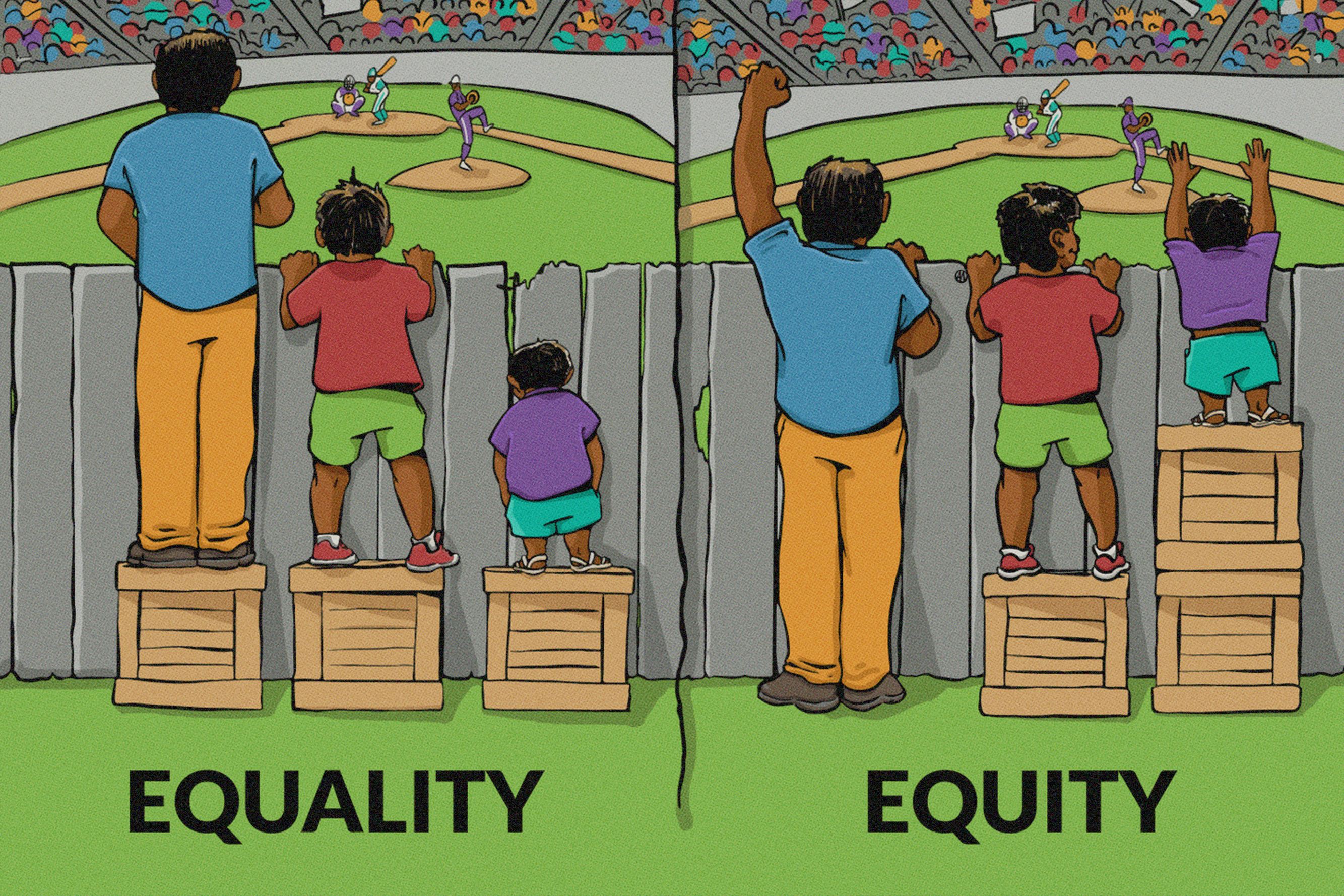
A whole lot of meaning is packaged in the word equity—a term Webster’s defines as “fairness or justice in the way people are treated.” However, the easiest way to understand equity is often through pictures, like the one below.
While this photo considers height as an inequity, in real life, income, access to food and health care are often at the heart of equity discussions. Surprisingly, a critical topic often overlooked in the equity discussion is where we spent 90 percent of our lives—in buildings.1
Oregon Metro, otherwise known simply as Metro, released a report discussing toxics reduction and equity. Its section on building materials connects building materials and equity, calling attention to the need to reduce community exposure to toxic building materials in an equitable manner. Building materials seem harmless and inert in our homes, offices, schools, or cafes. But in 1991, the Environmental Protection Agency (EPA) characterized indoor air pollution as “one of the greatest threats to public health of all environmental problems”.2
A large proportion of indoor air pollution stems from building materials.3 In particular, asthmagens are of highest concern and contribute to indoor air pollution through the release of chemicals from the surface of building finishes.4 For example, carpet, furniture and wall decor release chemicals through degradation or abrasion.5 The chemicals end up in dust in our homes and can enter our bodies through the lungs, skin or mouth.6 Volatile organic compounds emitted from paints are also of concern.7 In fact, a study of children in Australia showed a strong association among indoor home exposure to VOCs and increased risk of asthma.8 Over 70 percent of building material asthmagens identified by Healthy Building Network (HBN) researchers are not covered by leading indoor air quality testing standards.9 These hazardous wastes and products used in building materials disproportionately affect historically marginalized communities of color, children and low-income families.10
Equity in housing is especially important for many families with low incomes who live in multifamily housing.11 Multifamily housing often poses challenges to achieving better air quality as pollutants easily travel between units due to inadequate ventilation. Residents are usually unable to improve building infrastructure themselves.12
Incorporating building materials into the equity discussion is only part of the solution. Product testing for chemicals of concern, biomonitoring, community health impact research, chemicals research, advocacy and education all stand to make a larger collective impact.13
For funders looking to increase diversity and equity initiatives in their grant making, the building industry provides a blooming landscape to foster substantial impact within communities. Here are some key questions to consider when funding proposals:
So often, sustainability standards and initiatives are cost prohibitive, developed for those with the most access and resources, in hopes that “someday” the solutions will trickle-down. In the meantime, children and the populations with the lowest income continue to bear the burden of toxic exposures and preventable health consequences. Habitable’s Informed™ healthy product guidance is changing that old, unsuccessful paradigm. Our resources will result in healthier products for everyone, and amplify the prospect for a healthier planet.
Visit informed.habitablefuture.org to join the movement towards a healthy future for all.